

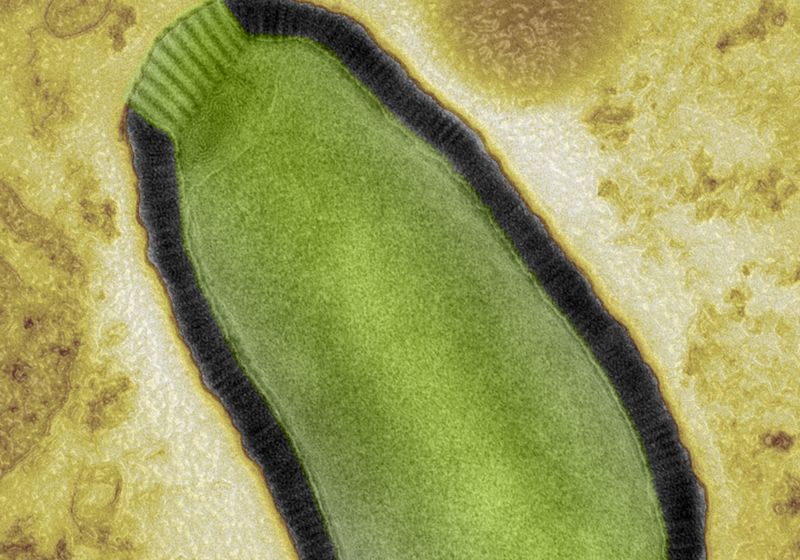
In 2003, Jean-Michel Claverie made a discovery in bacterial genomics that would change his career trajectory and begin a new era in microbiology. “One day, we found a very strange beast that nobody could characterize,” Claverie, now a semi-retired bioinformatician at the Aix-Marseille University, said, “It was not responding to the regular tests for bacteria.”
Growing in an amoebal host, this ‘beast’ had been isolated from a water-cooling tower in England following a pneumonia outbreak a decade earlier. It looked and acted like a parasitic bacterium, yet it could not be extracted using any established protocols, nor amplified using universal 16S rDNA bacterial primers. It wasn’t until Claverie and his colleagues examined it under a powerful electron microscope that they realized it wasn’t a bacterium at all—it was an enormous virus. “This changed my life, basically,” Claverie recalled.
Named Mimivirus for the way it mimicked the microbial prey of the amoeba, it had an icosahedral capsid with a diameter of about 400 nanometres—far bigger than typical viruses, making it unable to pass through 0.2 micron sterilizing filters. Its genome, too, was huge, clocking in at 1.2 megabases of double-stranded DNA.1 The team immediately wondered if this was a freak of nature or if there were more of these giant viruses hidden in plain sight. They started looking, and slowly but surely, the universe of giant viruses began to expand.
Now, more than 20 years after their initial discovery, these mysterious organisms continue to baffle and fascinate scientists and the public alike. It’s clear that giant viruses are abundant and diverse: Researchers have found them lurking in the vast expanse of the ocean, buried in the Siberian permafrost, deep in the Brazilian Amazon, and in forests, lakes, and rivers across the globe. But when it comes to the biology and evolution of giant viruses, there are still far more questions than answers.
Giant Viruses in the Ocean: The Viral Shunt
Giant viruses play a key role in marine food webs by infecting algae and protists. Here, hexagonal giant virus particles can be seen bursting out of a marine algae.
Grieg Steward and Christopher Schvarcz, University of Hawaii, Manoa
Marine microbiologist Mohammed Moniruzzaman’s interest was piqued when his PhD advisor discovered giant viruses infecting oceanic algae. “I got a big surprise looking at these giant viruses,” he said. “They have hundreds of kilobases of genome and hundreds to thousands of genes. That really fascinated me.” Now in his own lab at the University of Miami, Moniruzzaman continues to study giant viruses in marine ecosystems and how they affect their hosts.
As it turns out, giant viruses in the ocean play a key role in the marine food web; by infecting photosynthetic phytoplankton and protists, they contribute to the oceanic carbon sink, providing what is known as the viral shunt. “If those microbes are killed by viruses, the carbon they represent sinks to the bottom of the ocean and is not available as nutriment for [higher-level] organisms,” Claverie explained. In fact, around one-third of the ocean’s plankton is killed by viruses every day. Without them, Claverie added, “In less than one or two weeks, the ocean will look like a spinach soup.”
Moniruzzaman and his colleagues recently identified and sequenced the genomes of more than 200 new giant viruses, which they isolated from various locations across the world’s oceans.2 “In just one particular location, we can find hundreds and hundreds of them,” Moniruzzaman said. He added that their recent work has shown that “we have isolated more than 500 near-complete giant virus genomes from one sample in the ocean.”
According to Claverie, giant viruses are so ubiquitous that he and his team have simply stopped trying to isolate and sequence the genomes of individual viruses. Instead, the researchers focus on the molecular biology of giant viruses and how they replicate.
To explore the relationships between giant viruses and their hosts, Moniruzzaman’s team studies them in culture, infecting algae and examining the molecular biology of these interactions. “[We] really want to understand what is happening at the nanoscale, to be able to [make inferences] about the outcome of infection,” Moniruzzaman said. “What kind of nutrients are being released when the virus infects the cell? How does it impact the physiology of the host?”
Reviving the Zombie Virus: Are Giant Viruses Dangerous?

After other researchers suggested the zombie virus had been due to contamination, Jean-Michel Claverie travelled to Siberia to ensure permafrost samples were collected correctly.
IGS, CNRS
At times, Claverie’s research has strayed into the realm of the controversial. In 2012, he read a study that described growing fertile plants from viable seeds found in fossilized squirrel burrows embedded in the Siberian permafrost.3 Claverie had a crazy idea. “[I thought] ‘If those guys are able to revive a plant, we should be able to revive a virus’. So, we called them,” he said.
Fortunately, the team was able to study the same samples, from which they successfully isolated two giant viruses. Incredibly, even after epochs on ice, the ancient viruses could be revived and were able to infect their amoebal hosts. The media attention was significant, and Pithovirus sibericum, a 30,000-year-old giant virus, soon became known rather notoriously as the ‘zombie virus.’
Claverie and his team subsequently collected and tested more samples, which kept them busy for a long time. “Every single sample that we used was able to give us a new virus,” he said. The oldest zombie virus revived by Claverie’s team dates back 50,000 years, and they are currently working with samples from as far back as 300,000 years.
The revival of the zombie virus was met with public concerns. However, the fears surrounding this research were misdirected, according to Claverie. He explained that his team pragmatically only works on giant viruses that infect amoebas to reduce the risk of any human disease outbreaks. According to Claverie, the real danger lies in the effects of climate change and other anthropogenic factors—the permafrost is thawing more each year, and there are also active efforts to mine it for valuable minerals. “There is no reason if [amoeba-infecting giant viruses] could survive that long in permafrost, that other viruses will also be able to survive,” he said.
Using a metagenomics approach, Claverie and others have identified many relatives of modern human pathogens lurking in the permafrost, including poxviruses and herpesviruses. Russian researchers recently indicated that they were attempting to revive viruses from the permafrost that are capable of infecting mammoths. “I don’t think it’s a good idea,” Claverie said.
The Giant Virus Evolution Debate

Jean-Michel Claverie, a computational biologist, was part of a team that discovered the first giant virus, Mimivirus, in 2003.
IGS, CNRS
Another key aspect of Moniruzzaman’s research is the evolution of giant viruses—a topic on which he and Claverie have contradictory theories. Moniruzzaman and some other researchers suggest that giant viruses started small and gained genes along the way. “[Other researchers] have shown that the ancestral giant virus was not this big,” Moniruzzaman explained. “They had a core set of genes, and over time, they have picked up many genes, which slowly turned them into bigger particles.”
Claverie strongly disagrees. “At the moment, I believe that giant viruses appeared on the pathway of reduction,” he remarked. “They are [evolved from] organisms that were, in fact, even bigger in terms of gene number than they are. And like all parasites, they are losing genes as time goes on.”
Recent research could support Claverie’s less-popular theory. A characteristic that distinguishes viruses from eukaryotic cells is that they do not have the apparatus for protein translation. However, despite their lack of a ribosome, some giant viruses have genes that encode important protein translation machinery, such as aminoacyl transfer RNA synthetases. “To me, this is a real indication of a reduction mechanism [that giant viruses] are losing genes because they don’t need them,” Claverie commented.
A concept that Claverie and Moniruzzaman agree on is that giant viruses are thieves. “They do grab genes from their hosts,” Moniruzzuman said, adding that they “think these viruses actually are using these genes to manipulate certain host metabolic pathways or processes during infection. Having a copy of the same function that the host has sometimes helps the virus, to, say, overcome a certain metabolic bottleneck or suppress some kind of immune response of the host.”
More Secrets Hidden in Giant Virus Genomes
A key factor that makes studying giant virus evolution so challenging is that their genomes are so diverse. “When we found the first Pandora virus, I think the number was close to 90 percent of genes that had absolutely nothing in common with anything, including [eukaryotic] genes,” he said. Using AlphaFold, researchers have revealed some putative proteins from giant virus genomes, but the majority of genes remain a mystery.
Some giant viruses, like the Pandora viruses Claverie’s team discovered in Australia, can even make de novo genes. “That is, there is non-coding DNA, and they remove the stop codon, and all of a sudden it becomes possible to translate it, and they make a crazy protein that doesn’t do anything [straight away],” said Claverie. “But then those things start evolving, and some of them are stabilized during evolution, and they start having a function.”
According to Claverie, the mysterious genomes of giant viruses could be a treasure trove; the viruses use the same building blocks as eukaryotic cells, but can somehow biochemically manipulate them to produce molecules that are entirely different from those created by eukaryotic cells. “That could be a fantastic mine, actually, for innovation in the pharmaceutical industry, but I don’t think they realize that yet,” he remarked.
Moniruzzaman’s research into the genomes of giant viruses has also yielded some intriguing results. In one study, he demonstrated that giant viruses can integrate their entire genomes into those of their hosts.5 Even more interestingly, Moniruzzaman said, some of the integrated elements can actually provide some benefit to the host by responding to specific environmental stressors like temperature and UV radiation. “That’s exciting, this idea of viruses staying in a more friendly [relationship] with their hosts,” he added.
A recent note of discord in the giant virus community arose after a group of Chinese researchers suggested that some giant viruses could be a reservoir of antibiotic resistance genes.6 The claim was quickly refuted, then the original authors fired back, insisting their original claims were correct.7,8 Moniruzzaman weighed in on the debate and said the problem is an ontological one. “Of course, giant viruses cannot be killed using antibiotics, so [antibiotic resistance genes] cannot do anything. They might have homologous genes in them, but those genes do not necessarily perform the same function.”
Claverie added that it’s not giant viruses that should be a concern; although no one yet knows why, his metagenomics studies of permafrost samples have shown that ancient bacteria are extremely rich in antibiotic resistance genes. ‘With the superficial layer of permafrost melting, this could release bacteria that are carrying those genes, and because DNA can be transformed into modern bacteria, those old resistance genes could actually be propagated by modern bacteria,” Claverie said.
