

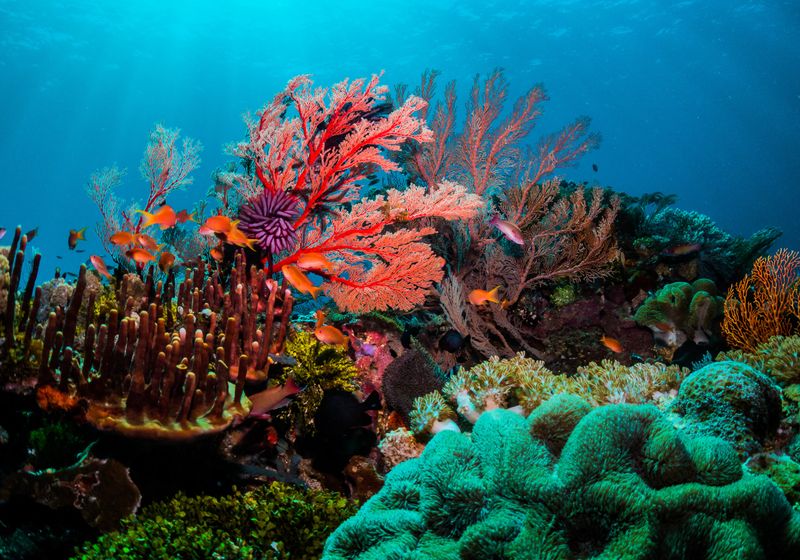
Coral reefs support roughly a third of all marine life.
Coral reefs make up a tenth of one percent of the ocean’s surface area but support up to a third of multicellular ocean species. The reefs provide valuable shelter from predators and ocean currents for many species, and they serve as a source of food for others.
Now, a new study suggests another role for reefs in setting a daily rhythm for microbes living nearby.
How Coral Reefs Support Ocean Microbial Life
Tropical coral reefs don’t just support larger marine species; they are also home to a huge range of microbes that live with corals in a mutually supportive relationship. These include tiny plankton from the family Symbiodiniaceae, which swap nutrients with nearby coral.
While researchers have extensively explored reefs and plankton, marine biologist and postdoctoral researcher Herdís Steinsdóttir and her team at the Interuniversity Institute for Marine Sciences in Eilat wanted to examine how the reefs’ interactions with these microbial communities varied in response to changes in the reefs’ primary energy source: light.
They found that over the course of a day, coral-based microbial communities grow and decline in patterns that are often more variable than those between two different sample sites on a reef.1 The authors said that their findings show that timing is an important factor in understanding reef ecology, which is something that single-sample studies might miss. They published their results in Science Advances.
The research team conducted a series of dives at the shallow coral in the Red Sea’s Eilat Nature Reserve. These included 24-hour studies, in which researchers visited the reefs and took water samples every six hours to observe how the day-night cycle altered their biology. They also conducted seasonal water-sampling dives in the winter and summer. The researchers compared their findings in the reef with those taken from the nearby open ocean.
Using these water samples, the researchers conducted in-depth genomic analysis of ribosomal RNA. They used flow cytometry to count the number of cells at different time points in their samples.
Reef Rhythms Affect Bacteria Numbers
The analysis showed that while reefs were rich refuges for multicellular life, there were fewer bacteria and microalgae in reef waters than in the open ocean. Microalgae were reduced by 75 percent in the reef samples. Despite this, some species were more common in reefs, including members of the family Alteromonadaceae. These bacteria thrived in the nutrient rich conditions offered by corals.
In comparison to the generally reduced bacteria numbers, more complex protists—which hunt and eat bacteria—were richly represented in the coral reefs, particularly at night. In sundown samples, protist numbers were increased by as much as 80 percent in the reef compared to open water samples. This finding suggests that reef-dwelling predators help keep bacterial numbers in check.
The team also looked at the daily shifts of Symbiodiniaceae as they lived beside their symbiotic coral. Regardless of season, the numbers of these tiny plankton peaked at midday. The researchers believe this suggests that coral rhythmically welcome and expel these plankton populations over a 24-hour period; although, exactly how they keep their symbionts in check is still unclear.
“These daily microbial rhythms were as strong as, and sometimes stronger than, seasonal differences,” said Steinsdóttir in a statement. “This shows that time of day is a critical factor when studying reef-associated microbial communities.”
