
Close Menu
My Blog

    Subscribe to Updates

    Get the latest creative news from FooBar about art, design and business.

    What's Hot

    Nautilus debuts Voyager platform in push toward next-gen proteomics

    March 1, 2026

    First-in-Human Success for Prenatal Stem Cell Therapy in Spina Bifida

    February 28, 2026

    Pressure-Driven Pathway Links Liver Congestion to Fibrosis and Cancer

    February 28, 2026
    Facebook X (Twitter) Instagram
    X (Twitter) YouTube
    My BlogMy Blog
    Sunday, March 1
    • Home
    • About Us
    • Healthy Living
    • DNA & Genetics
    • Podcast
    • Shop
    My Blog
    Home»DNA & Genetics»Organoids Reveal How Pressure and Growth Shape Pancreatic Lumens
    DNA & Genetics

    Organoids Reveal How Pressure and Growth Shape Pancreatic Lumens

    adminBy adminJanuary 9, 2026No Comments3 Mins Read
    Facebook Twitter Pinterest LinkedIn Tumblr WhatsApp VKontakte Email
    pancreatic organdies
    Share
    Facebook Twitter LinkedIn Pinterest Email

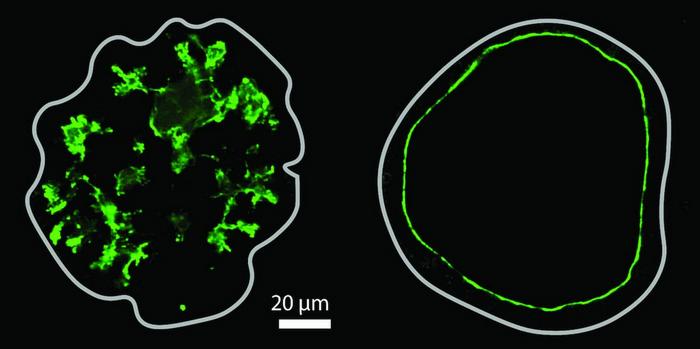
    Microscopic image with a star-shaped lumen on the left and a spherical lumen on the right. The apical marker Ezrin shown in green marks the lumen surface.
    [Byung Ho Lee et al. / MPI-CBG / Nature 2025]

    Working with organoids derived from mouse cells, researchers explored the processes involved in lumen formation in the pancreas and uncovered what controls the shape of lumens (fluid-filled cavities) during pancreatic development. They suggest that there are three main factors: how fast cells proliferate, the pressure inside the lumen, and the permeability of the cells around the lumen. More specifically, the shape of the lumen depends on the balance between the cell proliferation rate and the pressure in the lumen. Low pressure and high proliferation produce more complex or ‘star-shaped’ lumens. The pressure in lumens remain low because the surrounding pancreatic tissue is permeable.

    The discovered mechanisms could be relevant to other organs with complex ductal systems and to common cystic diseases. Furthermore, these findings could be used to develop new therapeutic strategies, including testing the effects of drugs for diseases.

    This work is published in Nature Cell Biology in the paper, “Permeability-driven pressure and cell proliferation control lumen morphogenesis in pancreatic organoids.”

    Lumens in the pancreas—fluid-filled spaces which are crucial for organ function and serve as transport and delivery networks—form a complex ductal system and its channels transport digestive enzymes to the small intestine. Understanding how this system forms in embryonic development is essential, both for normal organ formation and for diagnosing and treating pancreatic disorders. Despite their importance, how lumens take certain shapes is not fully understood, as studies in other models have largely been limited to the formation of single, spherical lumens. Organoid models can exhibit a range of lumen morphologies, such as complex networks of thin tubes.

    Pancreatic organoids “can form either large spherical lumen or narrow complex interconnected lumen structures, depending on the medium in the dish,” says Byung Ho Lee, PhD, postdoctoral researcher in the group of Anne Grapin-Botton, PhD director at the Max Planck Institute of Molecular Cell Biology and Genetics (MPI-CBG) in Dresden, Germany. “By adding specific chemical drugs altering cell proliferation rate and pressure in the lumen, we were able to change lumen shape. We also found that making the epithelial cells surrounding the lumen more permeable reduces pressure and can change the shape of the lumen as well.”

    More specifically, the authors write that “manipulating proliferation and lumen pressure can alter or reverse lumen development both in silico and in vitro. Increasing epithelial permeability reduces lumen pressure, converting from spherical to complex lumina.”

    “This discovery could help us understand how other organs with narrow interconnected ducts develop and how common cystic diseases affect them,” notes Grapin-Botton. “Our model system could further research in the field of organ development and tissue engineering and also potentially be used to test how different drugs affect diseases, which could lead to new treatments. This could help us better understand and treat diseases that affect the pancreas and other organs with branching ducts.”

    growth Lumens Organoids Pancreatic Pressure Reveal Shape
    Share. Facebook Twitter Pinterest LinkedIn Tumblr WhatsApp Email
    Previous ArticleSweet Deception: How Mycobacteria Exploit Immune Receptors to Survive
    Next Article Largest Immune Cell Atlas of Multiple Myeloma Predicts Recurrence Risk
    admin
    • Website

    Related Posts

    A Video Report from AGBT

    February 27, 2026

    Novo Nordisk, Vivtex Ink Up to $2.1B Deal to Develop Oral Biologics for Metabolic Conditions

    February 27, 2026

    Increasing Rice Yields with Gene-Informed Selective Breeding

    February 27, 2026

    Mutant p53 Selective Reactivation Demonstrated in Advanced Solid Tumors

    February 27, 2026
    Leave A Reply Cancel Reply

    Our Picks

    9 Time-Saving Kitchen Gadgets for Fall at Amazon

    September 5, 2025

    Why Exercise Is So Important For Heart Health, From An MD

    September 5, 2025

    An Engineered Protein Helps Phagocytes Gobble Up Diseased Cells

    September 5, 2025

    How To Get Rid Of Hangnails + Causes From Experts

    September 5, 2025
    • Facebook
    • Twitter
    • Pinterest
    • Instagram
    • YouTube
    • Vimeo
    Don't Miss
    Longevity

    Nautilus debuts Voyager platform in push toward next-gen proteomics

    By adminMarch 1, 20260

    Company’s new benchtop system promises a clearer view of proteins following validation at a leading…

    First-in-Human Success for Prenatal Stem Cell Therapy in Spina Bifida

    February 28, 2026

    Pressure-Driven Pathway Links Liver Congestion to Fibrosis and Cancer

    February 28, 2026

    A cellular atlas of aging comes into focus

    February 28, 2026

    Subscribe to Updates

    Get the latest creative news from SmartMag about art & design.

    About Us

    At FineGut, our mission is simple: to enhance your self-awareness when it comes to your gut health. We believe that a healthy gut is the foundation of overall well-being, and understanding the brain–gut connection can truly transform the way you live.

    Our Picks

    9 Time-Saving Kitchen Gadgets for Fall at Amazon

    September 5, 2025

    Why Exercise Is So Important For Heart Health, From An MD

    September 5, 2025

    An Engineered Protein Helps Phagocytes Gobble Up Diseased Cells

    September 5, 2025
    Gut Health

    Nautilus debuts Voyager platform in push toward next-gen proteomics

    March 1, 2026

    First-in-Human Success for Prenatal Stem Cell Therapy in Spina Bifida

    February 28, 2026

    Pressure-Driven Pathway Links Liver Congestion to Fibrosis and Cancer

    February 28, 2026
    X (Twitter) YouTube
    • Contact us
    • Privacy Policy
    • Disclaimer
    • Terms and Conditions
    © 2026 finegut.com. Designed by Pro.

    Type above and press Enter to search. Press Esc to cancel.