

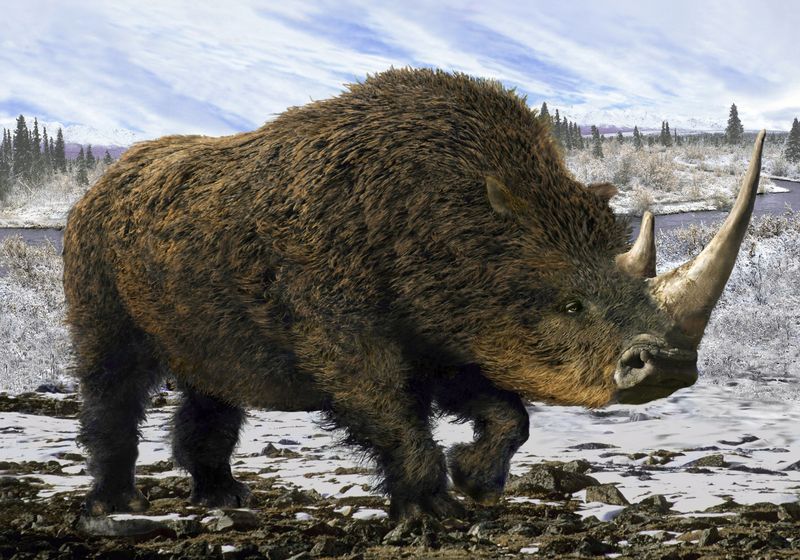
Researchers compared the genome of the earliest woolly rhinoceros found to date with two older specimens to better understand how it may have gone extinct.
The majority of all life ever to have existed in Earth’s history is extinct. Today, many organisms face extinction due to climate change and other factors that contribute to biodiversity loss. Researchers often turn to past examples of population decline to determine how a species met its end.
One of the paths is a loss of genomic diversity often caused by inbreeding as a population dwindles. Researchers investigate this by comparing genomes from a species at different time periods. These studies, however, require high quality DNA samples that are not always available in many ancient specimens.
Love Dalén and his team found a small piece of tissue from a woolly rhinoceros in the stomach of a wolf preserved in the Siberian permafrost. This piece of organic material allowed them to study the genome of this animal near the time of the species extinction.
Love Dalén
In a study published today in Genome Biology and Evolution, a team of researchers from Stockholm University and the Centre for Palaeogenetics isolated DNA from woolly rhinoceros tissue recovered from the stomach of a preserved wolf. They found that the woolly rhinoceroses, which lived during the most recent Ice Age, did not experience significant inbreeding.1 These findings not only suggest a rapid collapse of the species due to environmental changes but also demonstrated approaches to obtaining high quality DNA for genomic analyses.
“Recovering genomes from individuals that lived right before extinction is challenging, but it can provide important clues on what caused the species to disappear, which may also be relevant for the conservation of endangered species today,” said Camilo Chacón-Duque, a bioinformatician at the Centre for Palaeogenetics in a press release.
In a previous study, researchers sequenced the tissue to confirm it was from a woolly rhinoceros and used carbon dating to determine that the animal died approximately 14,000 years ago.2 It is the youngest specimen of this species found to date.
To study the genome of this new woolly rhinoceros further and to overcome limitations introduced by ancient samples, the researchers in the present study isolated DNA from 21 samples of tissue. They added these to the DNA extract isolated from the same animal in the previous study. Pooling these DNA samples allowed the researchers to generate a more complete map of the genome, demonstrating an approach to use otherwise poor samples to obtain high quality DNA for genomic analyses. Using shotgun sequencing, they obtained between 55 and 150 million reads per extract and mapped these to the closest living relative of the woolly rhinoceros.
Next, the researchers compared the genome from this woolly rhinoceros to two previously mapped woolly rhinoceroses’ genomes from animals that died approximately 18,000 and 49,000 years ago respectively. Using a computational model, the team estimated the three animals’ demographic histories to infer their population decline. The results pointed to all three species having stable population sizes as they gradually went extinct.
Finally, to assess a potential loss in genome diversity that would indicate population inbreeding, the team estimated the level of heterozygosity across the alleles in the genome for all three species. High heterozygosity and few homozygous regions would suggest low levels of inbreeding occurred. They calculated similar amounts of heterozygosity across the genomes and comparable numbers of homozygous regions across the three genomes. Specifically, the homozygous regions identified were short, which did not indicate recent inbreeding.
“Our results show that the woolly rhinos had a viable population for 15,000 years after the first humans arrived in northeastern Siberia, which suggests that climate warming rather than human hunting caused the extinction,” said Love Dalén, and evolutionary genomicist at the Centre for Palaeogenetics and Stockholm University and study coauthor in the same press release.
