


New research suggests Junevity’s siRNA approach could reverse age-related cellular decline without triggering dedifferentiation or cancer-related pathways.
A new paper published in the Proceedings of the National Academy of Sciences appears to validate the cellular reprogramming approach being developed by longevity biotech Junevity. The study describes research conducted at UCSF that led to the foundation of the company, and provides peer-reviewed evidence that aging-related cellular decline can be reversed by repressing a single transcription factor. The findings add credibility to Junevity’s vision of translating cellular rejuvenation into drugs capable of increasing human lifespan and healthspan.
The company’s research focuses on transcription factors, proteins that act as master regulators of gene expression and gradually become dysregulated as tissues age. Ever since Professor Shinya Yamanaka’s Nobel Prize winning discovery that an adult cell could be reverted back into an embryonic stem cell using a specific group of transcription factors, the concept of cellular rejuvenation has been a huge area of interest in longevity biotech, and companies including including Life Biosciences and NewLimit are focused on developing techniques to apply these factors transiently.
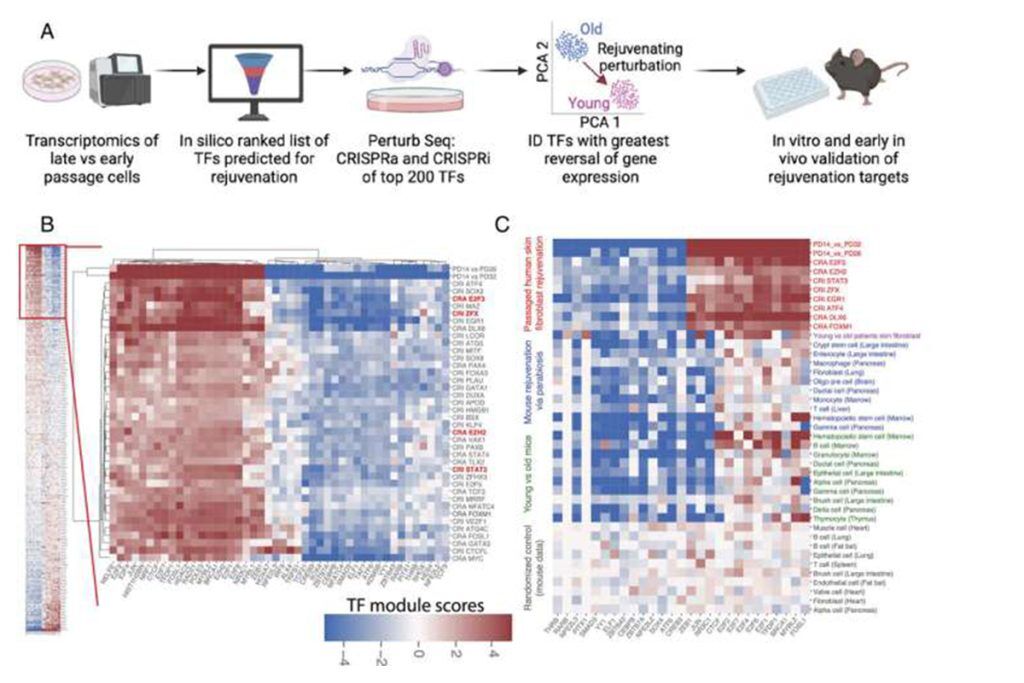
Rather than focus on Yamanaka factors, the UCSF research team, led by Junevity co-founders Dr Janine Sengstack and Dr Hao Li, set out to identify single regulators that could return cells to a healthier version of their existing identity, essentially mapping out which transcription factors were driving aging-associated gene expression patterns.
“Our work at UCSF laid the groundwork for the platform and therapeutics we are developing at Junevity,” said Sengstack, co-first author of the paper and Junevity’s Chief Scientific Officer. “In my PhD work, we set out to test the question: can we rejuvenate cells by repressing a single transcription factor? Our findings show that, yes, this is possible. This work supports the overall idea that Junevity is pursuing, where we repress a transcription factor with siRNA to treat aging related diseases.”
In human fibroblasts, cells responsible for maintaining the structural scaffolding of tissues, the researchers identified clear transcriptional signatures of aging linked to impaired mitochondrial function, loss of proteostasis and increased senescence. Out of dozens of potential regulators, four single-factor perturbations stood out for their ability to restore more youthful metabolic activity and proliferative capacity in aged human cells.
In aged mice, altering a single transcription factor’s activity led to measurable tissue-level benefits, particularly in the liver. The treated animals showed reversal of age-associated gene expression profiles, reduced fat accumulation and fibrosis in the liver, and improved glucose tolerance. According to Junevity, the findings suggest that resetting transcriptional control points can translate into meaningful metabolic improvements without triggering dedifferentiation or cancer-related pathways, a long-standing concern in the cellular reprogramming field.
The single-target discovery is key to Junevity’s approach. By showing that one transcription factor can coordinate multiple hallmarks of aging, the research supports the company’s use of small interfering RNA as a therapeutic modality. siRNA allows genes to be selectively silenced at the mRNA level, sidestepping the structural challenges that make transcription factors difficult to target with traditional small molecules.
“We created a platform that demonstrates systematic discovery of novel rejuvenating targets,” said Li, professor of biochemistry and biophysics at UCSF. “Its applications are broad for cell reprogramming and rejuvenation, and the platform approach can apply to many cell types, tissues and age-related diseases.”
In December, Junevity announced it had doubled its seed financing to $20 million, with the funding primarily earmarked for IND-enabling work on its lead program, focused on metabolic disease, previously described by Sengstack as “rejuvenation of the metabolism.” First-in-human studies are expected in the second half of 2026.
While metabolic disease is Junevity’s initial clinical focus, the company claims its approach is designed to be tissue-agnostic, with potential applications anywhere widespread transcriptional dysregulation plays a role in disease progression, such as neurodegeneration, muscle wasting and osteoarthritis.
