

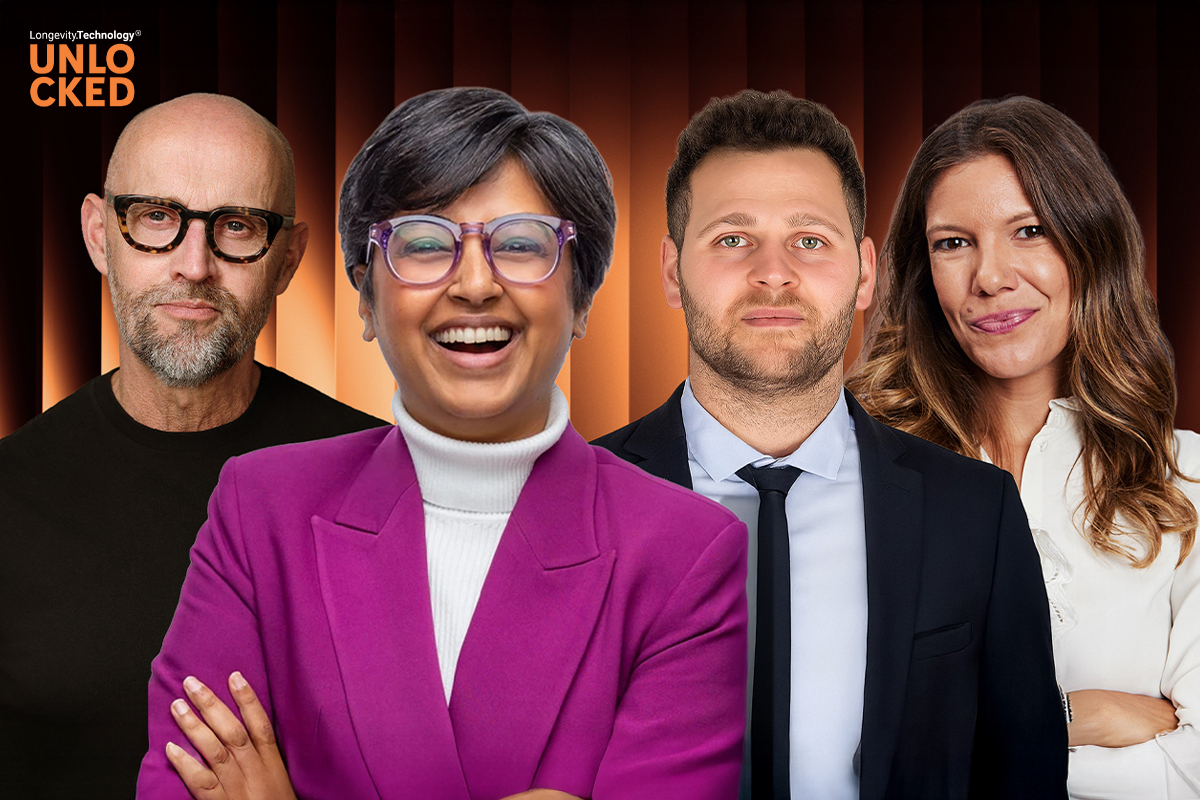
From bespoke stem cells to automated biology, two founders explain how personalization may finally scale in regenerative medicine.
For years, personalized medicine has been treated as a trade-off. You can have treatments built from your own biology, or you can have therapies that scale, but rarely both. The latest episode of Longevity.Technology UNLOCKED suggests that assumption may finally be breaking down.
The conversation centers on one of the most consequential shifts underway in regenerative medicine: the move from donor-derived, off-the-shelf cells to therapies built from a patient’s own biology. It is a transition that promises greater safety and precision, but also raises hard questions about cost, complexity and manufacturing.
As host Phil Newman notes early in the episode, stem cells are often treated as a single category. In reality, where cells come from and how they are made can radically change their clinical potential, ethical profile, and long-term relevance to longevity.
To unpack that tension, the episode brings together two founders working at different ends of the autologous spectrum: Vladik Krupalnik, CEO of Renewal Bio, and Nabiha Saklayen, CEO of Cellino. Their approaches differ, but their destination is the same: a future in which personalized cells are not rare exceptions, but part of the medical infrastructure.
Krupalnik’s path to Renewal Bio began with what he calls “a practical problem.”
“Medicine has a massive shortage of functional human cells and tissues,” he says, a reality underscored by a personal loss: “my friend passed away just because he didn’t have his own cell matched for transplantation to cure his lungs.”
Renewal Bio’s approach draws directly from developmental biology. By guiding induced pluripotent stem cells through early developmental stages, the company creates what Krupalnik describes as “stem cell-based developmental models.”
Krupalnik describes “day 14” as an internal shorthand for a breakthrough moment, when his team first saw lab-grown developmental models closely resembling early human embryos. That distinction, he stresses, is central to Renewal Bio’s approach.
The aim, instead, is practical: producing high-quality cells for transplantation by following the body’s own developmental logic. Looking ahead, the company plans to push further along this timeline, working toward models equivalent to day 28 of early development.
If Renewal Bio is rebuilding development, Cellino is rethinking manufacturing.
Saklayen came to stem cells from physics, asking a simple question: “Can I help biologists do something better, anything better?” What she encountered was a process that relied on rare human intuition.
“These incredible scientists have to sit and every day watch them, shepherd them, nurture them, decide which cells are good or bad using their magical eyes, hands, and brains,” she says. “It is a superpower.”
Cellino’s response has been to convert that intuition into systems. Using label-free imaging and algorithms, the company continuously assesses cell quality and determines how cultures should be managed in real time. Laser-based techniques replace manual handling, allowing precise control without opening containers or introducing contamination.
The ambition extends beyond technical elegance. Saklayen notes that creating a single autologous iPSC line once cost between $1 and $3 million. Cellino’s goal is to bring that down to around $10,000 per line by 2030.
Both founders describe their work as infrastructural rather than incremental. Saklayen characterizes Cellino as a moonshot that aims to enable millions of people to access therapies derived from their own biology. Regulators, she notes, are beginning to engage with that vision, as reflected in the company’s recent designation for advanced manufacturing technology from the US FDA.
What unites these approaches is a reframing of personalization – as a system that can be built, governed and scaled. Personalized cells and personalized futures are less about a single breakthrough than about an emerging architecture for regenerative medicine, one that may allow longevity science to grow without losing the individual at its center.
New episodes of Longevity.Technology UNLOCKED drop every Monday, featuring researchers, founders and thinkers shaping the future of aging science. A weekly news roundup follows each Friday.
Listen to today’s episode on Apple Podcasts, Spotify and YouTube, and join the conversation on whether automated biology is the missing bridge from one-patient miracles to real-world access.
