

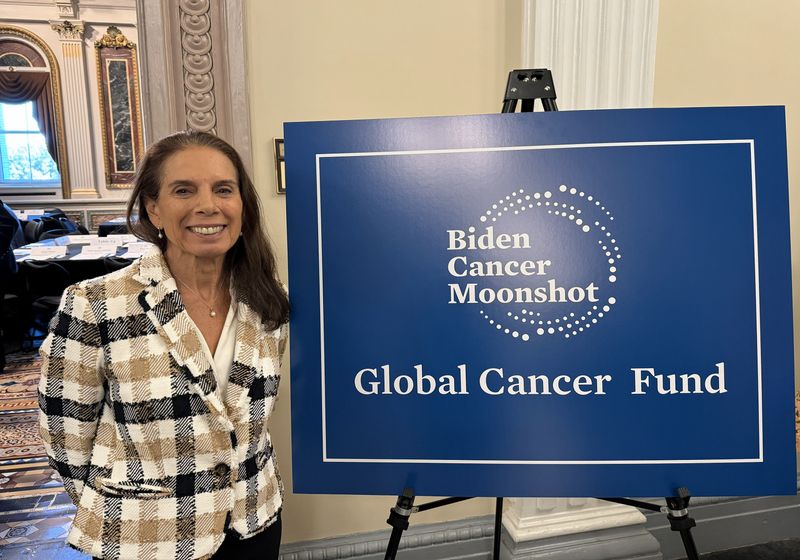
As a child in Manhattan, Anna Giuliano, a cancer epidemiologist at the Moffitt Cancer Center, experienced a cultural melting pot. Born to a Colombian mother and first-generation American father, she knew people whose families, like hers, had roots in other countries.
“I grew up in a very multicultural environment in the city and that was always something that I loved and I very much enjoyed,” said Giuliano. This motivated her to pursue a career that would help people from diverse backgrounds.
In the 1980s, after her graduate studies, she got her wish: a chance to study the human papillomavirus (HPV), which causes cervical cancer. “It turns out that cervical cancer has so many of the elements that I found interesting,” said Giuliano. “It continues to be and it definitely was in the 1980s a cancer of women…who are of lower socioeconomic status. It’s multicultural.”
Giuliano’s work has contributed to a better understanding of HPV-associated diseases in both women and men.
Moffitt Cancer Center
Over the next few decades, Giuliano studied the role of HPV in cancers in both women and men.1,2 She also played a central role in the clinical testing of HPV vaccinations to prevent cancers linked to the virus.3 She has led a number of cancer epidemiology studies and clinical trials among diverse populations in several parts of the world, contributing to a better understanding of the virus’s role in diseases in both women and men. Her work proved crucial in shaping HPV-linked cancer elimination statements and ensuing guidelines to achieve this from National Cancer Institute centers and the World Health Organization (WHO).
Trading the Violin Bow for a Pipette
Despite her extensive experience in cervical cancer research, Giuliano’s original career trajectory was completely unrelated. “My first goal in life was to be a concert violinist,” she recalled. However, as she attended the High School of Music & Art in New York, she realized she may not be able to achieve this dream—but another door opened.
“You’ll see this [in people who play] string instruments and piano. A lot of us tend to gravitate towards the math and sciences,” noted Giuliano. During her graduate studies at Tufts University, Giuliano became interested in pathology. When she expressed her enthusiasm in the field to Martha Hutchinson, who headed the pathology department at Tufts University at that time, Hutchinson offered her a piece of advice that shaped Giuliano’s career path.
“[Hutchinson] said, ‘This group from Germany has identified this virus that they think is the cause of cervical cancer. So, I want you to learn everything that you can about it’,” recalled Giuliano. This virus was HPV, which virologist Harald zur Hausen and his colleagues had found in cervical cancer samples. Scientists also found that DNA from HPV-16, the HPV type most commonly found in cervical cancer cells, could induce cancer-like traits in cultured cells, validating that HPV infections could cause cervical cancer.4
Given this compelling evidence and Hutchinson’s nudge, Giuliano knew what she wanted to do after finishing her graduate studies in 1989. “I’m going to prevent cervical cancer,” Giuliano declared back then. She chose to pursue a fellowship at the University of Arizona, where she could be close to the US-Mexico border, an area that had one of the highest rates of cervical cancer.5
Chasing a Better Understanding of HPV Infections and Cancers
At the University of Arizona, Giuliano crossed paths with gynecological oncologists Kenneth Hatch and Achim Schneider. Hatch was interested in learning more about nutrition in cervical cancer, and Schneider had trained under zur Hausen, who eventually went on to win the Nobel Prize for his discovery that HPV causes cervical cancer. A common goal united Giuliano, Hatch, and Schneider: They wanted to better understand HPV infections and cervical cancer. “It was a trifecta,” recalled Giuliano. “It was Ken as a physician, Achim, who set up the first HPV assays, and me as a burgeoning epidemiologist.”
However, the trio had to fight through meager funding, which was difficult to come by since cervical cancer incidence was low in the US. “We spent a lot of time writing grants and then revising and resubmitting and so on,” said Giuliano. “A lot of that time could have just been done spent working on the research.”
Despite this, they persevered and uncovered important insights about HPV infections and cervical cancer. One of their first findings was that people with recurrent HPV infections had lower antioxidant nutrients levels in their plasma. This helped establish that nutrient cofactors played a role in HPV infection risk.6 Beyond nutritional studies, Giuliano and her team’s epidemiological studies helped elucidate the rate at which HPV infections are acquired and cleared.7
Over time, she went on to investigate HPV in multicultural populations, realizing her dream of helping people from diverse backgrounds.
At the turn of the century, scientists recognized that people from minority populations were at risk of acquiring HPV infections due to poor diet, early age of first intercourse, and multiple sexual partners.8 However, few epidemiological studies included minority populations in the US, impeding scientists from getting a complete picture of HPV incidence among people from these backgrounds.9
Giuliano and her team recruited participants belonging to Black and Hispanic populations and found that they had a higher HPV infection burden compared to people from majority populations. This offered significant evidence that certain groups would benefit more from vaccination efforts.8,10
HPV Vaccine Testing in Women and Men
In 1999, Giuliano received a phone call that proved to be pivotal. Eliav Barr, who was leading the clinical development program for the HPV vaccine at Merck, contacted Giuliano seeking a collaboration. He had come across one of her research abstracts and hoped her expertise would help him and his team conduct vaccine trials in healthy volunteers and follow them up over a long duration. “I said, ‘Yeah this is wonderful. I’m so excited to be part of the program’,” Giuliano recalled.
The duo initially tested a monovalent vaccine—against one HPV antigen—followed by studies involving multivalent vaccines.11,12 This culminated in a broad-spectrum FDA-approved vaccine that protects against nine HPV strains that cause nearly 90 percent of all cervical cancers.13

As the president of the International Papillomavirus Society (IPVS), Giuliano presided over the final comments at the IPVS 2025 conference held in Bangkok.
Anna Giuliano
However, vaccinating women solved only half the problem. Studies in men revealed that they exhibited a higher prevalence of HPV infections compared to women.14 Through her own research, Guiliano also had a good understanding of the natural history of HPV infection and screening strategies in men.15 Since men could transmit HPV to their female sexual partners to potentially cause cervical cancer, Giuliano championed for the need to vaccinate men to protect both sexes against the virus.16 So, over time, Giuliano and Barr expanded their studies to include men and found that a multivalent vaccine protected them from HPV infection and its associated complications.17
Giuliano believes that her work on understanding HPV mechanism and investigating HPV vaccine efficacy in men has been her most impactful and significant contribution to the field.
Noel Brewer, a public health researcher at the University of North Carolina, who has met Giuliano at several conferences, agreed. “She’s made really important contributions to our understanding of HPV in men,” he said. “She helped to move the US and other countries to approve the vaccine for men by establishing the epidemiology of HPV and associated disease in men and the impact of HPV vaccination on men’s health.”
Setting Sights on Eliminating Cervical Cancer
When she moved to the Moffitt Cancer Center in 2004, Giuliano continued pursuing investigations related to cancer epidemiology among diverse populations. Her work offered a better understanding of HPV infections’ natural history, which expanded on the foundation laid by Pap smears for cervical screening.18 For instance, she helped measure the burden of HPV infections in cancers other than that of the cervix to quantify the rate at which infection occurred and got cleared.19,20 Parallelly, she continued working on improving HPV vaccinations and advocating the need to make the vaccines available.
“[Giuliano] is one of the leading figures who developed the argument that cervical cancer could be eliminated,” noted Brewer. She championed for the elimination of HPV-related cancers and argued that this was feasible in countries that have resources for immunizations, screenings, and pre-cancer treatments. She also acted as a consultant to the WHO regarding HPV vaccination and research on cervical cancer. “[Giuliano’s] powerful framing of the epidemiological data led the WHO to establish a global initiative to eliminate cervical cancer.”
Brewer noted that this helped increase the global reach of HPV vaccinations from 40 percent to roughly 90 percent of at-risk populations. “This will save millions of lives,” he added.
In fact, Giuliano’s work continues to strengthen the three main pillars which are the basis of WHO’s target for eliminating cervical cancer: HPV vaccination, cervical screening, and precancer and cancer treatment.18
In part due to her efforts, along with those of others in the field, the rate of cervical cancer cases has dropped from 9.3 new cases per 100,000 people in 1990 to 7.8 new cases per 100,000 people in 2021 globally. The incidence also reduced in the US from 10.2 new cases per 100,000 people in 1990 to 6.5 new cases per 100,000 people in 2021.
Maintaining a Legacy: Shaping Policies and Young Minds
Over time, Giuliano’s drive became a lesson for those she mentored. Brittney Dickey, who joined Giuliano’s group as a postdoctoral researcher in 2020, recalled how Giuliano advised her to define her career by a long-term goal.

Giuliano’s research extends to countries outside of the US. She participated in a three-day HPV workshop in Harare, Zimbabwe, focused on the basic science of HPV and associated diseases, and methods for their prevention, early detection, and treatment. Participants included people from Zimbabwe, Botswana, South Africa, and Zambia
Anna Giuliano
Towards the end of her postdoctoral fellowship, Dickey confided in Giuliano about her lack of motivation at the time. “She said, ‘You have to figure out what your passion is’,” recalled Dickey, now a public health researcher at University of Nebraska Medical Center. “And if you have that goal and you have something that you’re working towards every day, it helps motivate you in those small projects.”
Dickey observed this first-hand about Giuliano. “At some point along the way, she realized her passion was to eliminate HPV. It’s very evident that that drives her as a scientist,” said Dickey. Indeed, Giuliano persisted against all odds and went on to work toward her dream, laying the foundation for efforts—including better screening and vaccinations—aimed at eliminating cervical cancer.
Reflecting on her career, Giuliano said that one of the most exciting aspects has been seeing how well the vaccine works. “It is incredibly rare as a cancer researcher to develop a…product that has such great efficacy across the board across all males, females, different ages, different ethnicities, different world regions,” she said. “It’s just been phenomenal. It’s so hard to explain how wonderful that is.”
Despite the success, she acknowledged that the problem is not completely solved yet. According to her, scientists, investors, governments, and other stakeholders must come together to develop sustainable programs for global dissemination of the vaccine. She hopes that in this manner, all people who are eligible receive the vaccine. “That would be my dream.”
- Ferris DG, et al. Prevalence, incidence, and natural history of HPV infection in adult women ages 24 to 45 participating in a vaccine trial. Papillomavirus Res. 2020;10:100202.
- Dickey BL, et al. Persistence and clearance of oral human papillomavirus among a multi-national cohort of men. Nat Commun. 2025;16(1):8816.
- Maldonado I, et al. Effectiveness, immunogenicity, and safety of the quadrivalent HPV vaccine in women and men aged 27-45 years. Hum Vaccin Immunother. 2022;18(5):2078626.
- Yasumoto S, et al. Human papillomavirus type 16 DNA-induced malignant transformation of NIH 3T3 cells. J Virol. 1986;57(2):572-577.
- Giuliano AR, et al. Human papillomavirus infection at the United States-Mexico border: implications for cervical cancer prevention and control. Cancer Epidemiol Biomarkers Prev. 2001;10(11):1129-1136.
- Giuliano AR, et al. Antioxidant nutrients: Associations with persistent human papillomavirus infection. Cancer Epidemiol Biomarkers Prev. 1997;6(11):917-923.
- Giuliano AR, et al. Incidence, prevalence, and clearance of type-specific human papillomavirus infections: The Young Women’s Health Study. J Infect Dis. 2002;186(4):462-469.
- Giuliano AR, et al. Risk factors for high-risk type human papillomavirus infection among Mexican-American women. Cancer Epidemiol Biomarkers Prev. 1999;8(7):615-620.
- Giuliano AR, et al. Participation of minorities in cancer research: The influence of structural, cultural, and linguistic factors. Ann Epidemiol. 2000;10(8 Suppl 1):S22-34.
- Nyitray AG, et al. Prevalence of and risk factors for anal human papillomavirus infection in a sample of young, predominantly black men who have sex with men, Houston, Texas. J Infect Dis. 2018;217(5):777-784.
- Ault KA, et al. A phase I study to evaluate a human papillomavirus (HPV) type 18 L1 VLP vaccine. Vaccine. 2004;22(23-24):3004-3007.
- Villa LL, et al. Immunologic responses following administration of a vaccine targeting human papillomavirus types 6, 11, 16, and 18. Vaccine. 2006;24(27-28):5571-5583.
- Joura EA, et al. A 9-valent HPV vaccine against infection and intraepithelial neoplasia in women. N Engl J Med. 2015;372(8):711-723.
- Partridge JM, et al. Genital human papillomavirus infection in men: Incidence and risk factors in a cohort of university students. J Infect Dis. 2007;196(8):1128-1136.
- Dunne EF, et al. Prevalence of HPV infection among men: A systematic review of the literature. J Infect Dis. 2006;194(8):1044-1057.
- Giuliano AR. Human papillomavirus vaccination in males. Gynecol Oncol. 2007;107(2 Suppl 1):S24-26.
- Giuliano AR, et al. Efficacy of quadrivalent HPV vaccine against HPV Infection and disease in males. N Engl J Med. 2011;364(5):401-411.
- Hall MT, et al. Elimination of cervical cancer: The impact of HPV vaccination, primary HPV screening, and expanded access to cancer treatment services. Mol Aspects Med. 2026;107:101423.
- Giuliano AR, et al. Epidemiology of human papillomavirus infection in men, cancers other than cervical and benign conditions. Vaccine. 2008;26(Suppl 10):K17-28.
- Giuliano AR, et al. Incidence and clearance of genital human papillomavirus infection in men (HIM): A cohort study. Lancet. 2011;377(9769):932-940.
