

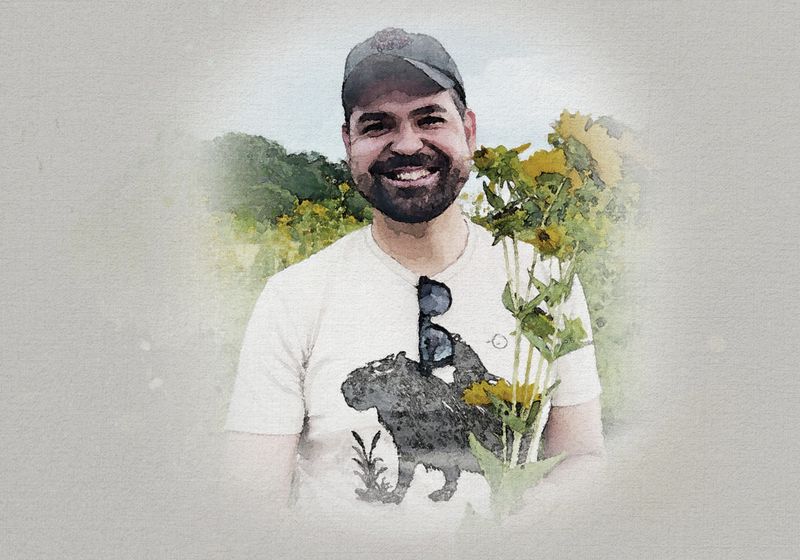
By studying perennial species like Silphium integrifolium, this postdoc explores how genetics can diversify global agriculture.
Renan Souza is a postdoctoral researcher working at the HudsonAlpha Institute for Biotechnology. In this postdoc portrait article, he discusses his work in genetics and plant breeding to develop novel and more resilient crops.
Q | What’s your research background?
My project involves the use of genome sequencing to identify genes important for plant domestication. We are working to develop novel crops to diversify our food production system.
Q | How did you first get interested in science?
I think it was in high school. I came across the book DNA: The Secret of Life by Andrew Berry and James D. Watson and just became fascinated with genetics. Many things in that book were obscure for me at that time, but from the first moment I opened it, I noticed that something important was being reported. At that point, I had already taken courses on genetics, but I had never stopped to think about how behind every piece of knowledge we have in this area, there were great researchers that designed elegant experiments out of curiosity and will to learn more. After reading that book, besides the courses I was taking in my undergraduate program, I started to study genetics by myself. After several internships in plant breeding, I decided to go to graduate school and do my master’s and PhD in genetics and plant breeding.
Q | Tell us about your favorite research project you’re working on.
My favorite project is the one I am working on right now. The recent advances in genomics and breeding methods gave us the ability to sequence several plant species that in the past did not have access to the technology. We are currently using sequencing as a central technology to help breeders make better decisions on what plants to select. One plant species I focus on is Silphium integrifolium, a perennial forb native to North America with deep root system and tolerance to droughts. Not only this plant is an iconic species native to the American prairies, but it also has great potential to become an oilseed crop.
Q | What has been the most exciting part of your scientific journey so far?
The most exciting part for me is when I have the opportunity to talk about my research in presentations to the public. I am really passionate about talking about plant breeding and how all the food we buy in the grocery store is actually a product of great effort of several scientists to make it resistant to pests and diseases, have high nutritional value and being affordable.
Q | If you could be a laboratory instrument, which one would you be and why?
I would be a thermocycler. It is just an amazing machine, and we can’t live without it. It is very versatile with hundreds of applications and uses. I kind of see myself like that: I try to learn a little bit of everything and be useful in the most ways I can in the lab.
Are you a researcher who would like to be featured in the “Postdoc Portraits” series? Send in your application here.
