

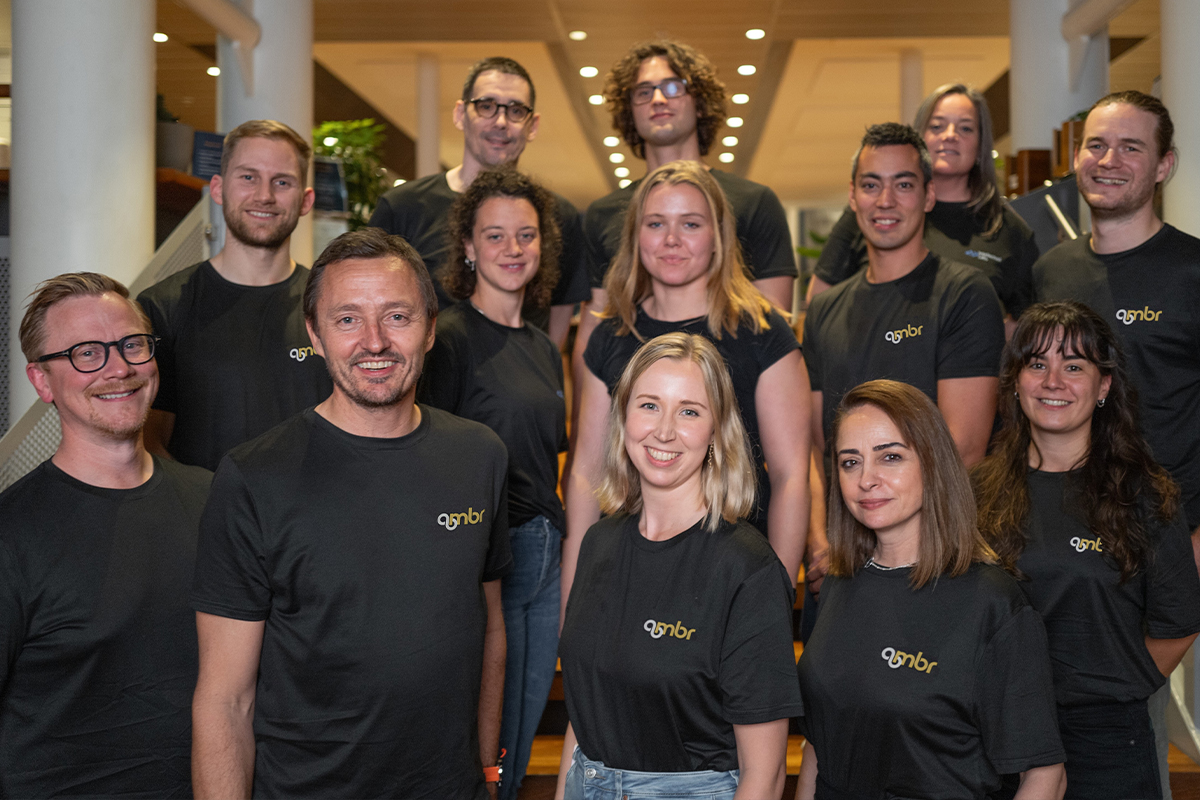
Ambr founder on how the startup is targeting population health with a prevention platform powered by ‘explainable AI.’
Norwegian healthtech startup Ambr has joined the global race to leverage AI to help move healthcare from its current reactive model to one based on proactive prevention. With age-related and chronic diseases accounting for the vast majority of healthcare spending and hospital deaths, the company’s pitch is that better prediction, clearer explanation and deeper patient engagement can help support doctors in the shift from treating illness to managing long-term health.
Ambr’s “explainable AI” platform, which integrates clinical data, biomarkers, lifestyle information and other biological inputs, is designed to provide physicians a clear picture of where a patient’s health is headed – and, crucially, what can be done about it. In a statement of its intent, the company recently announced it had signed a strategic partnership in the US with Columbia Basin Health Association – a federal health center with a mandate to treat those that cannot afford private health insurance.
Longevity.Technology: While “longevity medicine” is all too often talked about in the context of dedicated physicians and speciality clinics, Ambr takes the view that established primary care physicians are the ones who should be incorporating proven longevity science into their daily practice. Rather than build its technology for the longevity-conscious consumer, the company is seeking to reach those who in many ways stand to benefit most from preventive health – the mass populations served by major health systems. To learn more about Ambr’s ambitious plans, we sat down CEO and co-founder Valentin Normand.
A neuroscientist by training, Normand met Ambr co-founders, AI expert David Lindberg and serial entrepreneur Inge Grini, while studying for his PhD in Norway.
“We had very similar objectives in terms of vision, though we had different ideas about how to bring that to life, so we decided to team up,” he says. “Our mission is to bring longevity to everyone. We need to democratize it, learn from it, and bridge the gap between scientific discovery and state‑of‑the‑art research and actual clinical use.”
Delivering prevention at scale
While many startups in this area are seeking to adopt a direct-to-consumer approach, Ambr’s co-founders decided that the company’s first route to market would be the physicians at the point of care.
“For us it was clear that if we want to actually have an impact, we need to go to the doctor,” says Normand. “In the B2C space, you see many companies using tools that personalize the experience for patients. But on the doctor side, you don’t have an all‑in‑one tool that is well integrated with their platforms and that actually helps doctors do prevention at scale without increasing their burden. There was a clear market demand and a clear market space we are trying to take – we needed to find a way to engage doctors and help them do prevention.”
Having spent more than two years in R&D, assembling a team of PhDs to address the challenge, Ambr emerged last year with a platform design to help doctors assess all the data they have on their patients – lifestyle, biomarkers, genetic data – and forecast their aging trajectories.
“Across all the data you have, where is your patient heading?” says Normand. “Do you need to discuss prevention with that patient? Which patient do you need to discuss prevention with, and what do you need to discuss?”
Making AI ‘explainable’
Of course, time is of the essence in a primary care environment – doctors may have 10 to 20 minutes with a patient at best – so a key focus for Ambr was reducing the time needed to look at data.
“We help doctors identify all the risk factors that can correlate with each other, prioritize them, and make time in the consultation to actually show the patient how changing their lifestyle or sticking to their treatment will impact their future,” explains Normand. “It’s really a live simulation where the doctor can manipulate the digital twin of the patient and demonstrate how much impact they can have by changing something minimal.”
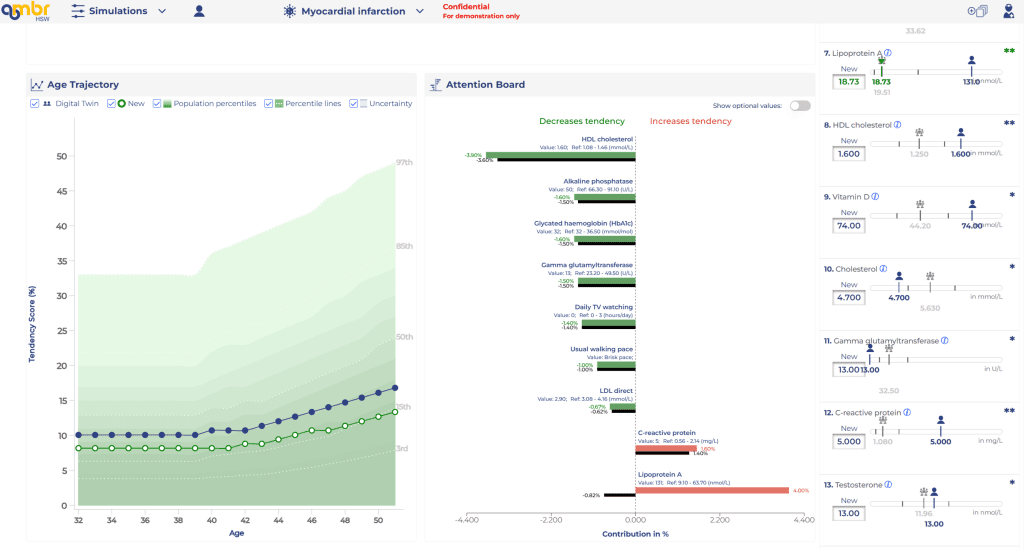
It was also important for Ambr that the company’s algorithms that are not opaque.
“We have a huge focus on what we call ‘explainable AI’,” says Normand. “We help doctors understand how the AI comes to a conclusion so they can trace all the risk factors back to clinical trials or peer‑reviewed papers that explain why they are relevant for a particular patient.”
“This helps with education and trust. Doctors can see why the algorithm says what it says, feel confident explaining it to the patient, and we believe that level of information needs medical supervision. You can’t just tell someone they have a high risk of chronic kidney disease without adequate context and professional guidance.”
Bringing prevention to the ‘masses’
The technology being developed by Ambr is perhaps the kind you might expect to find in high-end longevity clinics, and Normand acknowledges this was an initial area of focus for the company.
“At the beginning we targeted private clinics focused on longevity and preventive medicine, which really helped the software be developed and improved to a state‑of‑the‑art level,” he says. “But our mission has always been ‘healthy aging for all’ – we want to bring this everywhere, to everyone, so we are now rolling out the solution to public doctors, because that is how we reach the masses – the people who need prevention the most.”

The company is now engaging in clinical trials with different municipalities in the Nordic region, and is adopting a similar philosophy in the US, as evidenced by its partnership with Columbia Basin Health Association, a federally qualified health center, which is often required to provide care to people who cannot afford insurance plans.
“Our goal is to start testing with one of these centers and then scale within the FQHC network,” says Normand. “There are more than 200 of them, each with multiple clinics – so this is a huge market that aligns closely with our mission. These federal care centers serve around 10% of the American population. That is a massive market with massive demand, and they arguably need this more than people going to exclusive longevity clinics.
“Of course, we want to be a successful company, but we also want to have a real impact. Bringing prevention efficiently and accessibly to everyone is the way to address the real problem of aging: the sustainability of healthcare and society itself.”
Looking ahead, Normand says Ambr has a clear vision to enable decentralized healthcare with a strong focus on prevention in Europe, the US and beyond.
“We want every patient to be able to manage their own data, share it anywhere, and have something like a ‘health passport’ that contains their past, present and projected future – helping them manage that future,” he adds. “Our objective is to be the centralized tool that supports that entire journey – transparent, patient‑centered and prevention‑focused.”
The company is currently engaged in raising a seed funding round to help it achieve its objectives.
Photographs courtesy of Ambr.
