

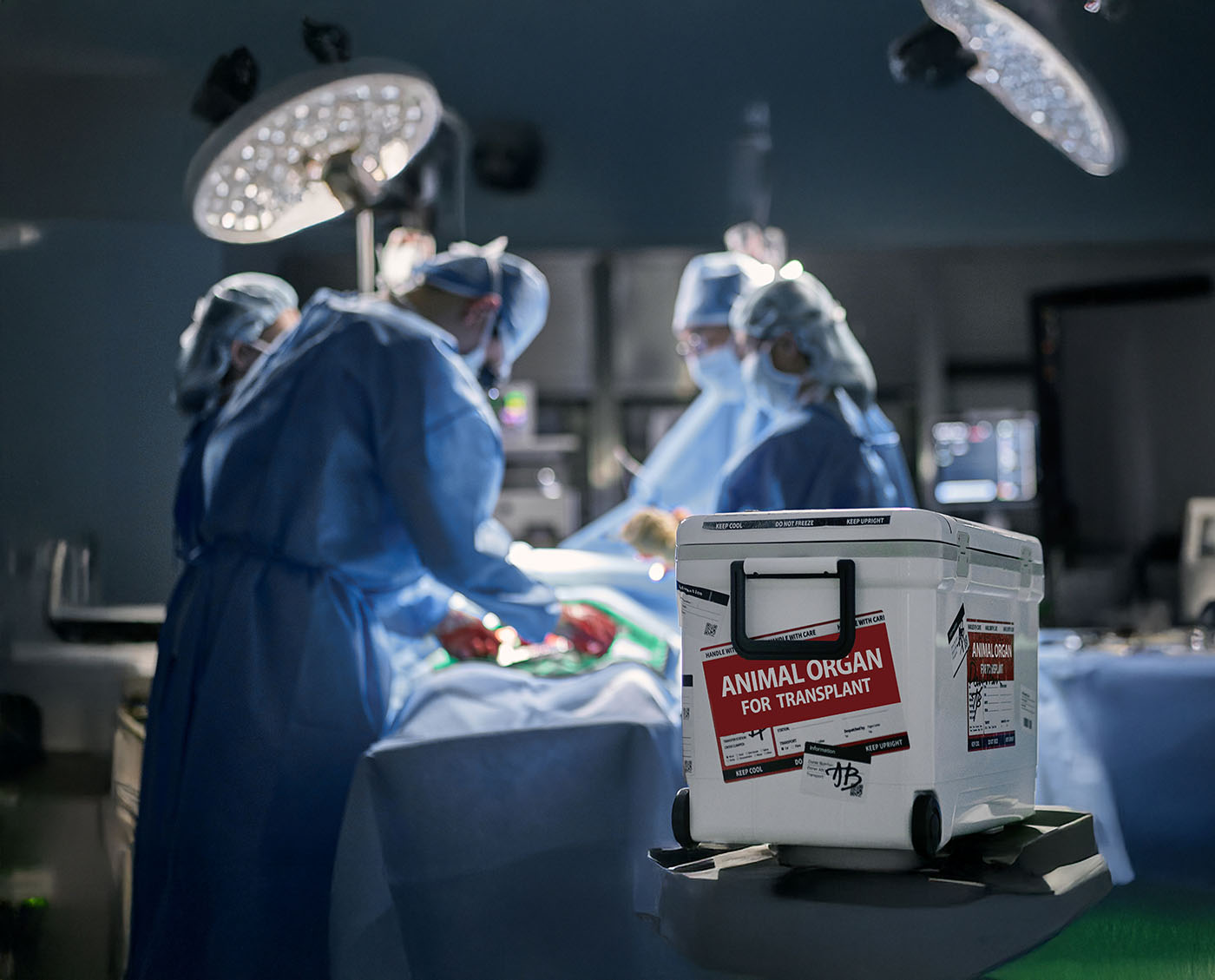
Researchers have made rapid progress in recent years toward understanding the molecular underpinnings of non-human organ rejection, offering hope that organ shortages can be overcome through xenotransplantation. Over 100,000 patients are on organ transplant waiting lists in the U.S. alone, and an average of 13 people die each day before getting a chance at a transplant. Safe and effective xenotransplants could help patients bridge the time between organ failure and the availability of a human transplant, or eventually, serve as a permanent alternative.
In the 1960s, scientists made some of the first successful attempts using organs from non-human primates. Since then, the pig has emerged as a more suitable donor animal due to greater availability and social acceptability. Genetic engineering technologies like cloning and gene editing have enabled modification of pig organs to minimize the risk of rejection, particularly hyperacute rejection, which is caused by donor-specific antibodies or antibodies with cross-reactivity and develops within minutes or hours of transplant. On September 30 through October 3, 2025, xenotransplantation researchers gathered in Geneva, Switzerland, for the 18th Congress of the International Xenotransplantation Association to discuss progress toward clinical implementation and long-term survival for xenotransplant patients.
Multi-omics in a decedent model
Brendan Keating, PhD, an associate professor of surgery at NYU Grossman School of Medicine and the Institute of Systems Genetics, presented results from a study of a pig kidney transplant into a recently deceased human recipient conducted over 61 days. The NYU team had previously used a decedent model to study the transplantation of genetically engineered pig kidneys over a 54-hour period. The longer time frame for the new study allowed Keating and his colleagues to monitor the organ and a series of successfully treated rejection events through a battery of multi-omics assays. “With the decedent model, you’re trying to mirror a living human in an ICU setting, but in a fail-safe environment where you can take as much tissue and blood as is feasible,” Keating said.
His group used a gene-edited kidney from United Therapeutics Corporation subsidiary Revivicor that is genetically modified to inactivate alpha-gal, a cell surface glycan that is associated with hyperacute rejection of pig organs. To produce xenodonors, the company uses gene editing methods to introduce the desired alteration in a large white pig, followed by somatic cell nuclear transfer into a surrogate to grow the genetically edited animal.
In results shared at the conference and published in November in Nature1, Keating’s team reported that the decedent avoided hyperacute rejection, but experienced antibody-mediated rejection at post-operative day 33. Keating’s group collected biopsy samples at ten intervals spaced out over 61 days to perform spatial transcriptomics, and a total of up to 64 blood samples for RNA-seq, single-cell RNA-seq, proteomics, and other assays. The assays revealed known markers related to organ rejection as well as new biomarkers specific to the pig kidney. “We think these are going to be very powerful as druggable targets and for figuring out other genes we should knock-out or knock-in with the next series of pig models,” Keating said.
The tests also allowed Keating and his collaborators to track significant clinical events throughout the 61-day course of the experiment, including early reperfusion, antibody-mediated rejection, and T cell-mediated rejection. Doctors successfully treated the organ rejection with anti-rejection medications. “At a molecular level,” Keating said, “we were able to distinguish xenotransplant from normal human-to-human allotransplant rejection.”
A bridge to registrational studies
Knowledge gained through decedent model studies has laid the groundwork for pig-to-human transplants in living recipients. Many of these have been conducted under compassionate use pathways and, increasingly, through formal clinical trials. United Therapeutics has launched the world’s first potentially registrational trial of a pig-to-human kidney transplant. The EXPAND trial will evaluate United Therapeutics’ UKidney in patients with end-stage renal disease who are not eligible for allogeneic transplant or are unlikely to survive long enough to receive one. The UKidney has 10 genomic alterations designed to avert organ rejection in the human recipient.
Jayme Locke, MD, a transplant surgeon and vice president of medical development, xenotransplantation at United Therapeutics, presented the trial design at the IXA conference. “Kidney transplantation is the gold standard therapy for patients with kidney failure,” Locke said. “But the gap between supply and demand is vast. The world’s organ shortage is an unmitigated disaster.”
Investigators will transplant the UKidney in two participants sequentially. When the second participant has reached 12 weeks post-transplant, the company will open a second trial site and may enroll up to four more patients. In October, the surgical transplant team at NYU Langone Health performed the first xenotransplantation within the study. If all goes well, United Therapeutics hopes to increase the number of patients and sites in the study to support a biologics license application submission.
A strategy against rejection
eGenesis is developing porcine organs for transplant by comprehensively addressing viral risk and molecular incompatibilities that drive rejection. Researchers at eGenesis have incorporated three sets of alterations into the Yucatan miniature pig using CRISPR-Cas9 gene editing and somatic cell nuclear transfer. The first set inactivates endogenous retroviruses, a total of 60 edits. A second round of gene edits knocks out genes that produce three cell surface glycans related to hyperacute rejection—alpha-gal, Neu5Gc, and Sd(a). Lastly, eGenesis scientists insert seven human transgenes that address mechanisms of graft rejection.
The company has transplanted three of its gene-edited porcine kidneys into human donors, and in one case, a patient has survived 271 days before the donor kidney failed, setting a record for the longest survival with a pig organ transplant. In September, the FDA cleared an investigational new drug application submitted by eGenesis to begin a clinical trial of its gene-edited porcine-derived kidney in patients with end-stage kidney disease.
Director, Computational Biology
eGenesis
In a presentation at the IXA conference, Sagar Chhangawala, PhD, director of computational biology at eGenesis, shared results from a comprehensive next-generation sequencing analysis demonstrating that edits at all 70 loci were successful while avoiding any significant unintended genomic alterations.
The company used multiple platforms, including long-read PacBio whole genome sequencing (WGS), Nanopore direct RNA-seq, Nanopore WGS, and Bionano’s Optical Genome mapping. They confirmed all intended edits and deeply characterized any unintended alterations. Additionally, Illumina RNA-seq and Nanopore direct RNA-seq technologies were used to quantify expression and verify the integrity of added human transgenes. “Using the state-of-the-art methods, including long-read sequencing technologies, for deep characterization in an unbiased manner is something we have not seen in the field,” he said
Chhangawala emphasized eGenesis was able to make close to 70 edits in the porcine genome without any significant unintended genomic variation risk, bolstering the company’s confidence in the safety of the engineered organs for patients. The company plans to continue using comprehensive NGS to study its organs and to further refine its donor porcine organs via gene editing.

A hardier breed of donor pig
While most research groups rely on organs from cloned, gene-edited pigs created through somatic cell nuclear transfer for pig-to-human transplantation, scientists at the Center for Innovative Medical Models (CiMM) at LMU Munich’s Faculty of Veterinary Medicine are taking a different approach.
Speaking at the conference, Elisabeth Kemter, DVM, a professor at CiMM, noted that cloning efficiency is highly variable and can result in unpredictable epigenetic alterations. Although the Munich group initially generated their gene-edited pigs using somatic cell nuclear transfer, the animals ultimately selected as organ donors are produced through conventional breeding. According to Kemter, this approach enables the reliable production of donor pigs without epigenetic changes.

[Barbara Kessler, Center for Innovative Medical Models at LMU Munich]
The pigs carry knockout modifications in the genes responsible for producing alpha-gal, Neu5Gc, and Sd(a), along with several integrated transgenes. However, because breeding colonies with multiple gene edits are small, maintaining these lines over several generations poses significant challenges. Inbreeding can lead to reduced fertility and viability, complicating efforts to scale up donor pig production. Instead, the Munich group is selectively breeding the Auckland Island pig, a feral breed of domestic pig that has lived on the subantarctic Auckland Island since 1807. The Auckland Island pig is highly inbred with low genetic variation compared to other breeds of pigs. They are also largely pathogen-free and their heart size is suitable for human adults. Despite the inbreeding, Kemter said, due to the harsh conditions on Auckland Island, the pig is very fertile and produces large litters. “Only the fittest survived under the very harsh conditions [on Auckland Island],” Kemter said.
Rather than pursuing a large number of genetic modifications, the Munich-based team led by biotechnology pioneer Eckhard Wolf favored a minimal set of gene edits while placing strong emphasis on the quality of transgene expression. The porcine endothelium plays a critical role in preventing hyperacute and acute vascular rejection. “This is the site where good transgene expression is essential,” Kemter said. Immunohistochemistry staining of the team’s xenodonor pigs showed strong transgene expression in the endothelium, while the targeted genes were successfully knocked out. Hearts from these gene-edited minipigs are now being used in preclinical xenotransplantation studies at LMU.
References
- Montgomery, R.A., Stern, J.M., Fathi, F. et al. Physiology and immunology of a pig-to-human decedent kidney xenotransplant. Nature(2025).
