

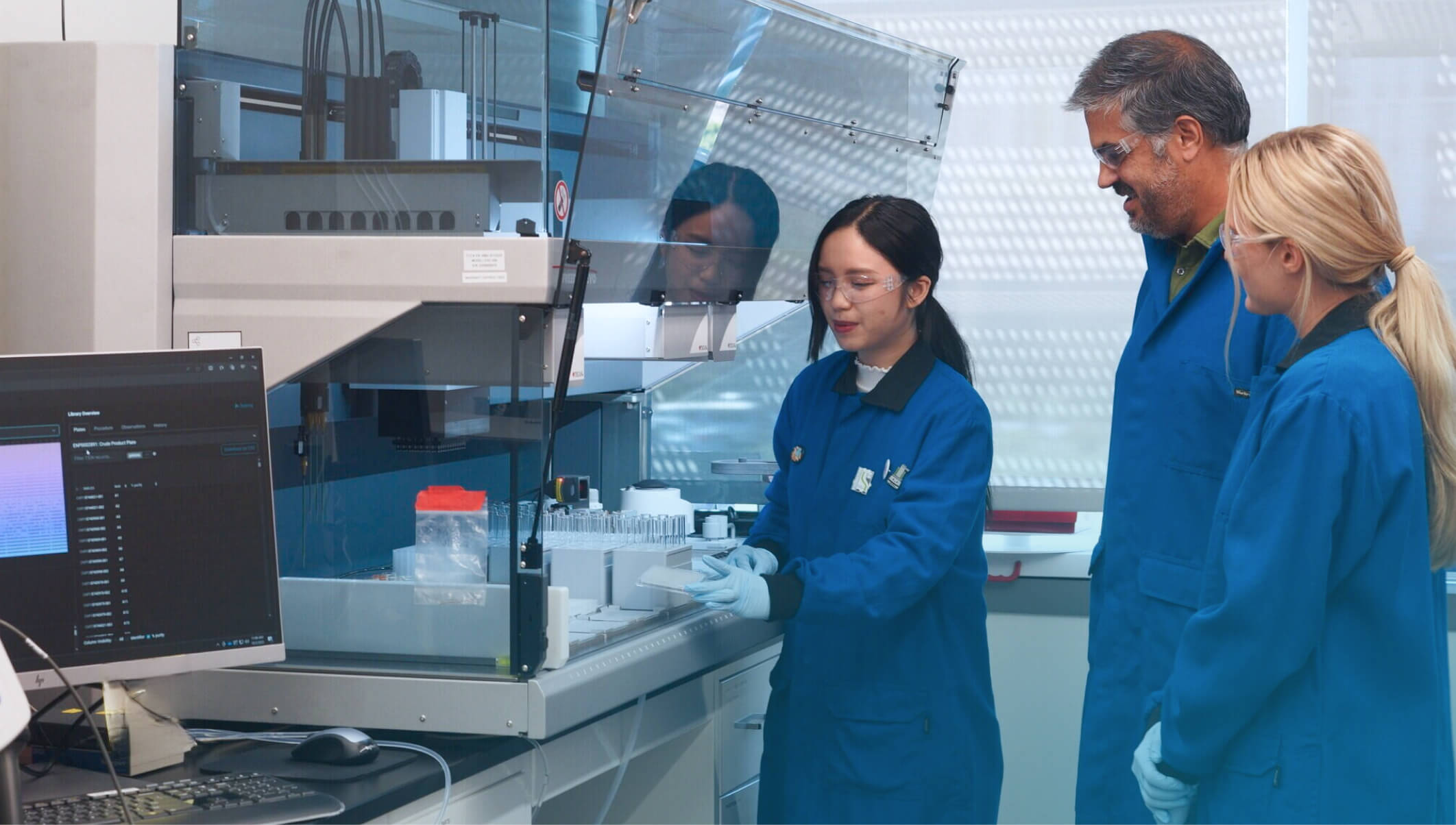
Takeda Pharmaceutical will apply Iambic Therapeutics’ artificial intelligence (AI)-based technologies and wet lab capabilities to design and develop small molecule drugs starting with two of Takeda’s therapeutic areas through a multi-year tech and discovery collaboration that could generate more than $1.7 billion for the San Diego biotech, the companies said.
Takeda has agreed to use Iambic’s AI drug discovery models toward advancing a set of high-priority small molecule programs in the pharma’s therapeutic areas of oncology and gastrointestinal and inflammation.
In addition to oncology and gastrointestinal and inflammation, Takeda’s areas of therapeutic focus include neuroscience, plasma-derived therapies, rare diseases, and vaccines.
“Iambic has shown success in cancer and other domains and believes that our computational and experimental approaches are widely applicable across therapeutic domains and event therapeutic modality,” Michael Secora, Iambic’s CFO and chief corporate development officer, told GEN.
Through the collaboration, Takeda is being granted access to Iambic technologies for AI drug discovery.
One technology is Enchant, a multimodal transformer model trained on dozens of data modalities and sources from across drug discovery and development. Enchant is a computational tool designed to facilitate preclinical and clinical endpoint prediction by supplementing clinical data with laboratory data, with the goal of making reliable predictions of human pharmacokinetics and other clinical drug properties from the earliest stages of discovery programs.
Last year, Iambic announced Enchant v2, an upgraded version of the model that is designed to provide accurate predictions for dozens of biological, physiochemical, pharmacokinetic, metabolic, safety, and other properties essential for clinical success.
Another Iambic technology Takeda plans to apply is NeuralPLexer, a computational approach designed to directly predict protein–ligand complex structures solely using protein sequence and ligand molecular graph inputs. NeuralPLexer uses a deep generative model to sample three-dimensional structures of the binding complex and their conformational changes at an atomistic resolution.
“Iambic’s computational and experimental technologies work in concert with each other using ideas like uncertainty quantification (UQ) and active learning within the context of fast DMTA (design-make-test-analyze) cycles,” Secora explained. “It is not enough to make a prediction. One needs to understand the certainty of the prediction and if there are biases that are skewing what may be an accurate prediction.”
“With such UQ, one can employ active learning and consider what parameter spaces could be enriched with additional data or even potentially avoided. Here, our computational tools give us a structural view of biology and the broad consequences of chemistry, which can then be tested and refined in our laboratory,” Secora added.
Better molecules faster
Iambic says its automated laboratory is capable of over 95% medicinal chemistry transformations, where the company routinely generates more than 1,000 molecules a week, in order to design better molecules faster for its partners.
In a 2024 study published in Nature Machine Intelligence, researchers from Iambic, Nvidia, and California Institute of Technology (Caltech) reported that NeuralPLexer consistently outperformed AlphaFold2 in accurately conveying global protein structure on both representative structure pairs with large conformational changes and recently determined ligand-binding proteins, owing to its specificity in sampling both ligand-free-state and ligand-bound-state ensembles.
“Takeda will have access to our industry-leading technology NeuralPLexer in order to fine-tune a model and direct it to computational applications of their choosing,” Secora said.
Secora added that Takeda’s access to NeuralPLexer is nonexclusive and will parallel the technology enablement and research collaboration that Iambic entered into with Revolution Medicines last year.
In that partnership, the companies agreed to use Iambic’s AI models to pursue novel drug candidates using Iambic’s leading AI models. Iambic agreed to use structures and molecular libraries provided by Revolution Medicines to train bespoke versions of NeuralPLexer.
Revolution also gained access to Iambic’s PropANE model, a pre-trained graph neural network deployed across dozens of drug properties for lead selection and optimization, while Iambic agreed to build custom versions of NeuralPLexer and other technologies trained on Revolution Medicines’ proprietary data to inform drug discovery against novel drug targets.
“We have experienced significant partnership momentum over the last year or so, entering five major partnerships. Each of these partnerships highlights the breadth and depth of the Iambic value proposition,” Secora said.
Revolution and Takeda are two of several other larger biopharmas that have partnered with Iambic in AI drug development. Two others are:
- Lundbeck—Iambic launched a strategic research collaboration of undisclosed value with the Danish biotech in September 2024, focused on the discovery of a small molecule therapeutic for the treatment of migraine.
- Jazz Pharmaceuticals—In October, Iambic entered into a research collaboration and drug supply agreement of undisclosed value with Jazz Pharmaceuticals. Jazz agreed to provide Ziihera® (zanidatamab), a HER2-targeted bispecific antibody, at no cost to Iambic for evaluation in combination with IAM1363, Iambic’s brain-penetrant HER2 small-molecule tyrosine kinase inhibitor. The combination will be studied in patients with HER2-positive breast cancer who were previously treated with Enhertu® (fam-trastuzumab deruxtecan-nxki; also known as T-DXd).
Positive data
The Jazz partnership came a month after Iambic presented positive data from a Phase I/Ib trial (NCT06253871) for IAM1363 at the European Society for Medical Oncology (ESMO) Congress. IAM1363 was shown to have anti-tumor activity and a favorable safety profile across HER2-wild-type and HER2-mutated cancers, as well as in multiple disease indications.
In June, Iambic selected Lambda, an AI infrastructure developer and GPU cloud company, to provide an NVIDIA HGX B200 cluster to support the training of Enchant. The companies have since been partnering on model training using Enchant and NeuralPLexer.
“Watch for new and bigger versions of these models in the near-term,” Secora said.
Takeda has agreed to pay the San Diego biotech an upfront payment of an undisclosed amount, research costs, and technology access payments. The pharma also agreed to pay Iambic up to $1.7 billion-plus in payments tied to achieving milestones.
Iambic is also eligible to receive royalties on net sales of any products generated from the collaboration with Takeda.
How did Takeda and Iambic get together?
“Both groups have had respect and admiration for each other, and several members of both organizations have talked about breakthrough ways of doing drug discovery and development research,” Secora recalled. “It is great to pull these like-minded and ambitious groups together.”
He cited a January 9 LinkedIn post from Andy Plump, Takeda’s president, research & development, detailing his company’s approach to AI drug discovery and its selection of partners:
“We have prioritized AI partners with unique capabilities that can augment our development efforts (Nabla Bio, CytoReason) and have achieved clinical or strong preclinical validation of their platforms. When it comes to data infrastructure and integration with our evolving AI and ML computational capabilities, we prioritize partners (TetraScience) that bring a ‘move fast’ mindset and a willingness to embed closely with our teams,” Plump explained.
“Amazing progress is possible when an ‘all in as one team’ spirit prevails in these collaborations,” Plump added.
