

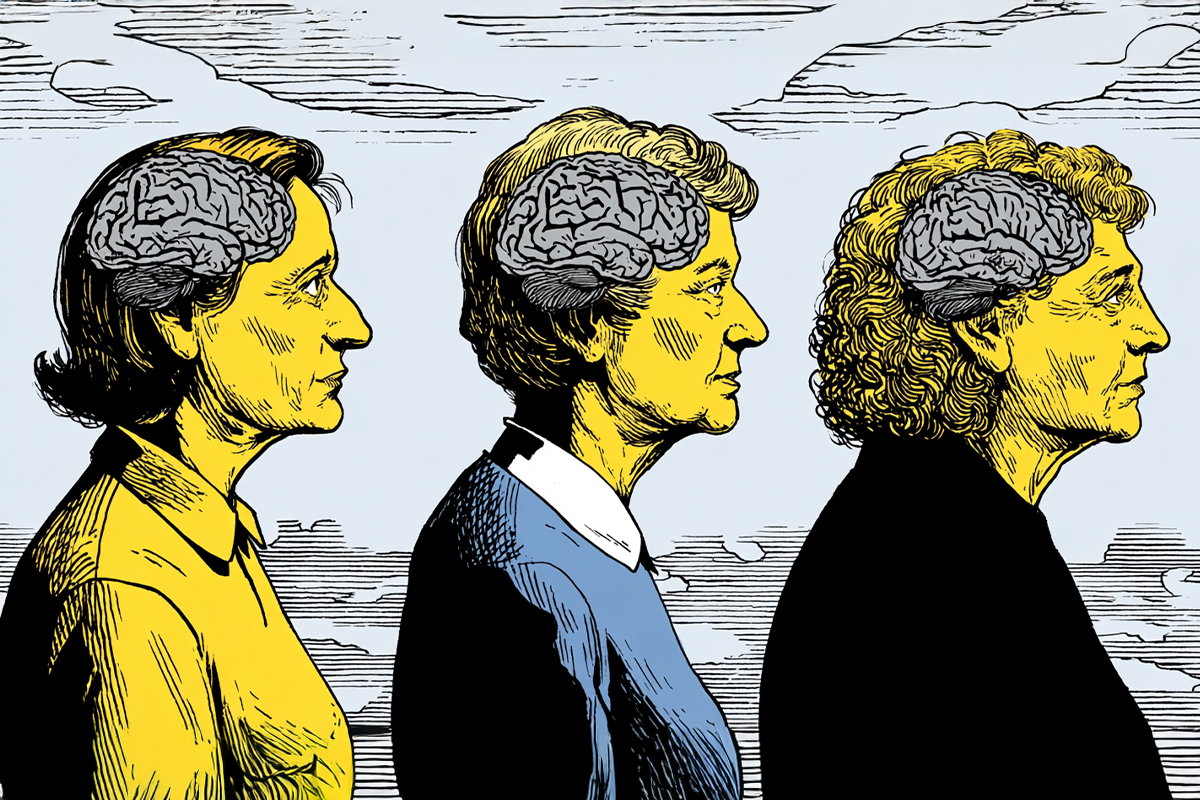
UK Biobank study connects gray matter differences with sleep disturbance and mental health during post-menopause.
For decades, the conversation around menopause has been stuck in a loop of hot flashes and night sweats – a narrative of physical discomfort that often misses the deeper biological transformation going on in women. But a new analysis from the University of Cambridge, leveraging the massive scale of the UK Biobank, suggests the story is significantly more “neurologically textured” than we’ve given it credit for. It turns out that post-menopausal women show distinct differences in gray matter volume within the very regions responsible for memory and emotional regulation, a structural shift that arrives alongside a trio of disruptions: anxiety, depression and fractured sleep [1].
The research, recently published in Neuropsychopharmacology, didn’t just look at snapshots; it interrogated the health data and brain scans of thousands of women across the menopausal spectrum. What the authors describe isn’t a subtle drift but “widespread associations” between hormonal status and neural architecture. Specifically, the “thinning” clusters in the hippocampus, entorhinal cortex and anterior cingulate cortex – the essential circuit boards for memory formation and affective processing [1].
Longevity.Technology: Menopause is still too often treated as an inconvenient footnote to reproductive life rather than what this UK Biobank work suggests it may be – a neuroendocrine inflection point with measurable associations across brain structure, mood and sleep; that is geroscience territory, not lifestyle-page fluff. The temptation, of course, is to turn this into an HRT morality play; yet the paper’s own details should make us pause, because women using HRT also report higher symptom burden and mental health difficulties, which hints at indication and selection effects rather than a neat “treatment causes X” storyline [1].
More interesting is the systems pattern: gray matter differences clustering in regions tied to memory and emotional regulation, coupled with worse sleep and anxiety or depression measures – a trio that rarely behaves politely in midlife, then echoes forward into cardiometabolic risk, cognitive vulnerability and workability in aging societies. This is why longevity medicine cannot keep treating women’s brain health as a niche concern; if an age-linked, hormone-driven transition is nudging neural resilience off course, the answer is not panic or platitudes but longitudinal tracking, better phenotyping of HRT timing and formulation, and preventive support that takes sleep and mental health as core infrastructure. Quietly consequential. Deeply under-modeled.
Brain structure and mood
In their analysis, the authors report that post-menopausal status was associated with smaller gray matter volumes in key limbic and paralimbic regions. These differences were accompanied by higher self-reported anxiety and depressive symptoms, as well as poorer sleep quality.
Dr Joanne Langley, first author of the study, said: “Our findings show that menopause is associated with changes in brain structure, and that these changes are linked to mental health and sleep disturbance.” She added that while such differences do not equate to neurodegenerative disease, they may represent a sensitive period of brain vulnerability [2].
Yet, the cognitive data told a subtler story. Despite those structural changes, memory performance barely flinched after the researchers corrected for other variables. It points to a curious disconnect: perhaps the brain is actively compensating for its shrinking limbic real estate, or maybe structural thinning simply hasn’t hit the threshold of functional failure yet. Whatever the reason, brain structure and cognitive function, it seems, do not march in lockstep.
The HRT question
Hormone replacement therapy inevitably sits at the center of such discussions. In this dataset, women using HRT showed lower gray matter volumes in some regions compared with both pre-menopausal and post-menopausal non-users [1]. Yet the authors also note that HRT users reported more severe menopausal symptoms and poorer mental health, raising the possibility that women experiencing greater symptom burden are more likely to seek treatment.
Professor Ulrike Zühlsdorff, senior author, cautioned against simplistic interpretation: “It is important to emphasize that this study is observational. We cannot conclude that HRT causes these brain changes [2].” The design does not allow causal inference, nor does it capture granular detail on formulation, dose, route or timing of HRT initiation – variables known to influence outcomes.
Professor Barbara Sahakian, a co-author, highlighted the broader implications for women’s health. “Menopause is a natural transition, but it can have significant effects on women’s mental health and wellbeing,” she said. “Recognizing this can help us to develop better support and treatment strategies [2].”
The paper itself calls for longitudinal studies to disentangle age effects from menopausal status and to explore whether brain differences persist, stabilize or reverse over time [1]. Cross-sectional snapshots are informative; they are not destiny.
A systems transition
In geroscience terms, menopause isn’t some isolated reproductive sunset; it’s a total systems overhaul. We are looking at a coordinated retreat of signaling that hits everything from metabolic regulation to stress physiology. Because the brain is effectively an estrogen-responsive organ—saturated with receptors that govern synaptic plasticity and inflammatory tone – estradiol acts less like a simple hormone and more like a master architect of neural infrastructure. When mood, sleep and limbic structure all start drifting in unison, the question isn’t whether the symptoms are “annoying.” The question is how the midlife neural landscape is being fundamentally rewritten.
The stakes here are high and deeply gendered. Women carry a disproportionate burden of dementia globally, and while we can’t draw a straight line from midlife structural shifts to late-life decline just yet, this transition is clearly a high-stakes crossroads for future resilience. Sleep fragmentation and depression aren’t just “lifestyle” hurdles to be managed; they are the early, quiet ripples of cardiometabolic and cognitive vulnerability. In longevity medicine, prevention rarely shouts. It whispers in the patterns we’re finally starting to track.
Beyond the reproductive frame
The Cambridge study does not argue for alarm, but it does, however, invite a reframing. Menopause is neither trivial nor pathological; it is a biologically complex transition with systemic consequences that extend beyond fertility.
The real work for longevity science lies in taking these signals and folding them into a far more sophisticated model of female brain aging – one that finally accounts for the interplay of hormonal timing, social stress and the sheer noise of individual biology. We need deeper, longitudinal data, certainly, but we also need the policy gravity to pull these findings out of the “niche” bucket and into the clinical mainstream.
Aging is not gender-neutral. Nor should prevention be.
[1] https://www.cambridge.org/core/journals/psychological-medicine/article/emotional-and-cognitive-effects-of-menopause-and-hormone-replacement-therapy/E9D94A6EB0B8A3C03113A93D34A99FD0
[2] https://www.cam.ac.uk/research/news/menopause-linked-to-loss-of-grey-matter-in-the-brain-poorer-mental-health-and-sleep-disturbance
