

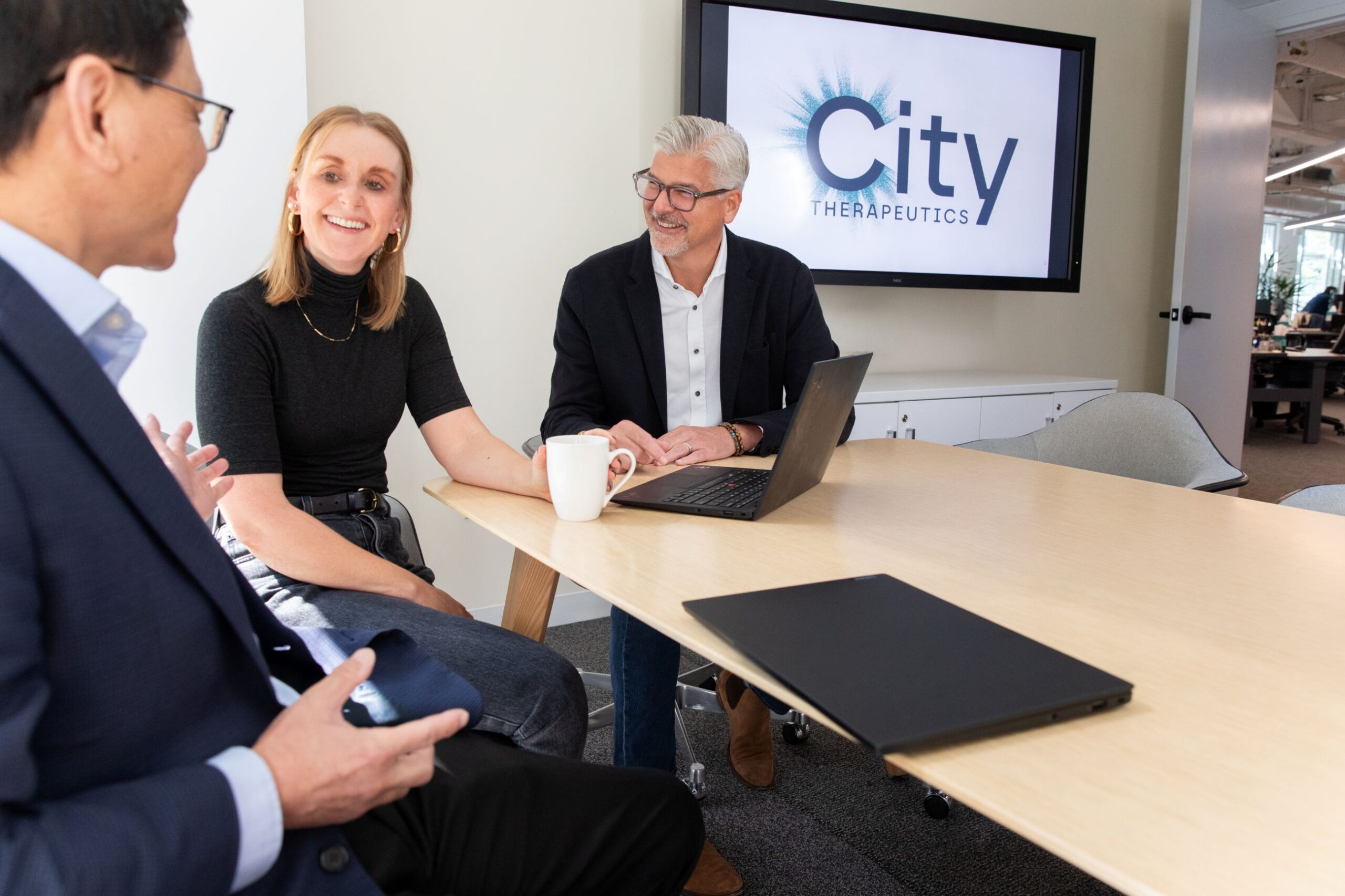
About a year after retiring as founding CEO of Alnylam Pharmaceuticals, where he led pioneering efforts to develop drugs based on RNA interference (RNAi), John Maraganore, PhD, came across a paper in PNAS detailing how tiny RNAs called cleavage-inducing tiny guide RNAs (cityRNAs) induced gene silencing by enabling the argonaute-3 (AGO3) protein to slice through other proteins.
From that paper, published in 2020 by Kotaro Nakanishi, PhD, of Ohio State University and colleagues, Maraganore wondered: Could cityRNAs penetrate tissues that could not be reached by traditional siRNA molecules? The answer turned out to be, yes. At approximately 14-17 nucleotides long, cityRNAs are smaller than the small interfering RNAs (siRNAs) that form the backbone of most RNAi therapies to date. As a result, cityRNAs can access multiple types of tissues beyond liver, including tissue of the CNS, eye, muscle, fat, and lung.
“I was like, whoa, this is super interesting! I talked to my colleagues at Arch, and we decided to start a company,” Maraganore recalled while joining CEO Andy Orth for a recent interview with GEN. After Alnylam, Maraganore has nurtured new RNA-based startups as a venture partner with Arch Venture Partners, an advisor at Atlas Ventures, a senior advisor at Blackstone Life Sciences, and an executive partner at RTW Investments, in addition to his work as an advisor at various companies.
“We all know from drug discovery and drug development work that you really have to optimize these molecules. Sometimes making them smaller makes them more efficient, makes them better to get to different tissues and in different cells in the body to treat different diseases. That was the foundational science that really led to forming City Therapeutics,” Maraganore said.
Critical optimizations
“It’s our belief that these types of optimizations around the molecule will be critical to making best-in-class drugs at the end of the day, which is what our focus is. That’s an example of the type of innovation in the field which we’re pioneering at City.”

What wowed Maraganore and colleagues about cityRNAs?
“The fact that you’re able to make a smaller trigger of RNA interference in a cell means that you can improve the physical and chemical properties of the drug, and we never thought that we could do that,” he replied. “That was the foundation for getting started with this next generation approach, at the end of the day. It really was around making these molecules distinct, smaller, and improved from a physical and chemical property perspective. That is really unique.”
City’s eight co-founders include Maraganore, who is the company’s executive chair, and Nakanishi, a scientific advisor to the company. Arch led the $135 million Series A financing with which City Therapeutics formally launched in 2024, with no less a goal than “to lead the future of RNAi-based medicine” by “harnessing next-generation siRNA engineering to improve and expand the therapeutic reach of RNAi-based medicines.”
That therapeutic reach today includes the eight FDA-approved drugs based on siRNA. The most recent approval came in November, when the agency authorized Arrowhead Pharmaceuticals’ Redemplo® (plozasiran), an apolipoprotein C-III (apoC-III)-directed siRNA, as an adjunct to diet to reduce triglycerides in adults with familial chylomicronemia syndrome (FCS).
Six of the eight siRNA drugs that were developed by Alnylam, starting with Onpattro® (patisiran), the first siRNA therapy to win FDA approval in 2018. Orth oversaw the launch of Onpattro and two other Alnylam-developed therapies, Givlaari® (givosiran) for adults with acute hepatic porphyria (AHP), and Oxlumo® (lumasiran) for adults and children with primary hyperoxaluria type 1 (PH1).
Orth reunited with Maraganore in 2024 to run City as CEO after a stint as chief commercial officer at Krystal Biotech, where he oversaw the global commercialization strategy and launch of Vyjuvek® (beremagene geperpavec-svdt), a dystrophic epidermolysis bullosa treatment and the first-ever topical redosable gene therapy authorized by the FDA a year earlier.
‘Pretty, pretty tantalizing’

“When John began to speak a little bit about what City was doing and leading the next generation of RNAi, that was immediately very attractive. So, it was the ability to be back in this field, and what frankly I think a lot of us have always felt, the amount of headroom for this modality across all sizes of diseases, all types of diseases, et cetera, really exists. And to be able to be part of someone conquering that’s pretty, pretty tantalizing.”
Maraganore said City does not foresee that potential being diminished by the sort of regulatory resistance experienced by developers of messenger RNA (mRNA)-based vaccines: “There’s no read-through to small interfering RNA molecules or RNAi, which are completely different. They don’t stimulate an immune response, they’re not part of a vaccine strategy, so there’s just no relationship with them whatsoever.”
“We started City Therapeutics to really lead that next generation of RNAi. There’s no question that there’s more opportunity for innovation in the RNAi field and City is an example,” Maraganore said. “This is a modality that is going to be in use medically for the next 100-plus years, and the companies that need to get started to drive new innovation in the space are going to be really, really important.”
City launched its first clinical program last fall, when it began a Phase I study (NCT07430397) of its lead pipeline candidate CITY-FXI, a next-generation siRNA anticoagulant designed to prevent clots leading to conditions such as stroke and deep vein thrombosis without increasing bleeding risk by targeting Factor XI. The blood coagulation protein enables blood clotting by activating factor XI within the coagulation cascade. That helps generate thrombin, a protein that converts fibrinogen to fibrin, which traps platelets and helps hold a clot in place.
“Factor XI is genetically and biologically a target that allows you to block clotting without blocking bleeding. There are people that don’t have the gene, or who have part of it because of genetics. And they’re incredibly protected from developing a blood clot. They don’t have any bleeding consequences from it,” Maraganore said. “When you target [Factor XI] with an RNAi drug, you can achieve this highly durable knockdown, reproducing the genetics, and make a normal person that lucky SOB that doesn’t happen to have that gene anymore.
‘The beauty of RNAi’
“And that’s the beauty of RNAi, to really be able to phenocopy, as we like to say, human genetics,” Maraganore added.
Orth said the Phase I study has approximately 40 healthy volunteers, including a cohort of people with increased risk of clotting. Data from the study is expected to be read out by the end of this year. The company is conducting its Phase I studies for CITY-FXI in the U.K., with plans to have sites in the U.S. for later-stage trials.
City’s pipeline includes two wholly owned preclinical cityRNA programs, both in investigational new drug (IND)/clinical trial application (CTA) phases. One is CITY-RBP4, a therapy designed to slow or halt Stargardt disease progression by decreasing expression of the liver-produced protein RBP4. City expects to file for a CTA in the summer and launch a Phase I trial shortly thereafter, Orth said.
“It’s a subcutaneously delivered form of siRNA to the liver for an ocular disease. And essentially what the modality is doing here is inhibiting, to a certain level, the delivery of vitamin A to the eye, and it is that vitamin A within the visual cycle in these poor Stargardt patients which then causes a toxic buildup into the eye,” Orth said. “We’ve seen some de-risking of this modality from some other clinical data in the past year, and we’re very excited here to get this trial moving as quickly as possible.”
The other is a treatment for an undisclosed disease based on an unspecified target the company calls “Target 3” within hepatic tissue. “It’s a little bit bigger in terms of a disease state than the Stargardt program—not as large as anticoagulation, but something we’re excited to share when we can,” Orth said. “We hope to file that CTA at the end of this year.”
Big-name biotechs
Also in City’s pipeline are programs partnered with a pair of big-name biotechs. City is partnering with Bausch + Lomb on a novel RNAi treatment for retinal diseases including geographic atrophy targeting a specific but undisclosed target within ocular tissue for intravitreal administration. Bausch + Lomb agreed to pay City an unspecified upfront payment—and if Bausch + Lomb elects to pursue a candidate for further development, City could also receive up to $485 million tied to achieving development, regulatory, commercial, and sales milestones, plus tiered royalty payments on net product sales.
“If approved, this would be the first ever intravitreal siRNA,” Orth said. “We would hopefully reach the stage of a development candidate in 2026, and then we’ll hand it off to Bausch, and they’ll handle the clinical development from that point forward.”
With Biogen, City is partnering on a program to treat an undisclosed disease through an undisclosed target that mediates key central nervous system diseases, combining an RNAi trigger molecule to be developed by City with drug delivery technology from Biogen. “They came to us for our expertise in the siRNA or cityRNA world and asked us to develop that portion of the molecule. So, we’re partnering with them, to bring something together for the CNS space.”
The Biogen collaboration will initially focus on a single target, using tissue enhanced delivery technologies with the aim of allowing for systemic administration of medicines. Biogen agreed to pay City $16 million upfront plus a $30 million investment in exchange for a City convertible note representing a minority equity interest in the company if converted. Biogen also committed up to approximately $1 billion in potential payments tied to achieving milestones, plus tiered royalties in the high single-digit to low double-digit range based on net sales.
Both the Biogen and Bausch + Lomb collaborations “are going exceptionally well,” Orth said, though City isn’t discussing details.
“We’d love to do more partnerships like these, where someone is in need of, or has a great use for an siRNA or a cityRNA, and we can help them get it to the right tissue type using our platform. We’ll continue to innovate internally from our own platform, but as well, likely do partnerships for other modes of delivery.”
Headquartered in Cambridge, MA, City has grown its workforce to about 65 people working from offices and labs at Kendall Square, with plans to add around 20 people this year to help build out its clinical, regulatory, and manufacturing operations.
“We’re agnostic to therapeutic area. I think we’re more interested in what are perfect targets for sRNA that haven’t been explored yet. We are going where the science takes us,” Orth said. “We have faith in the ability to get to a vast majority of these novel cell types, and use this technology. We’re starting with ocular, we’re starting with CNS, but that’s really just the beginning.”
