

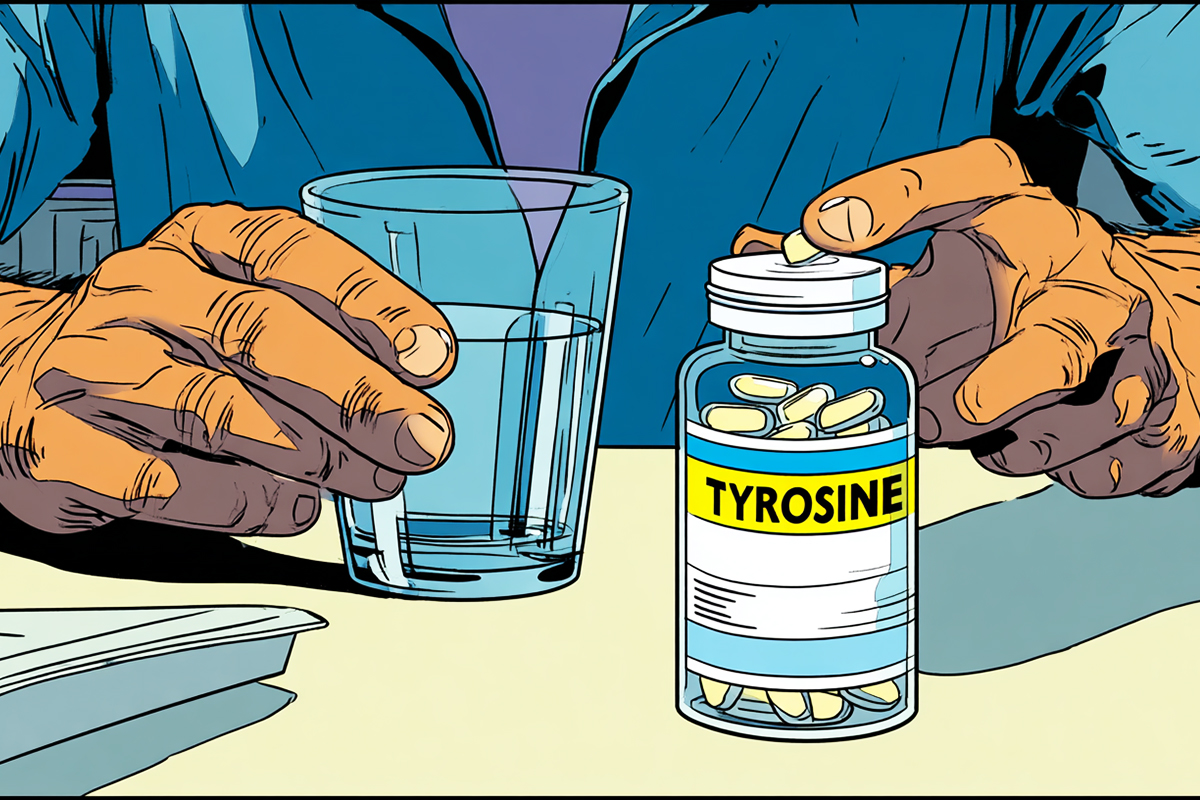
A large UK Biobank study links the common amino acid tyrosine to reduced longevity, with stronger effects in men.
If you zoom in far enough on the human body, longevity begins to look less like a lifestyle slogan and more like chemistry. A new study published in Aging suggests that higher levels of one amino acid called tyrosine may be linked to a shorter lifespan. Drawing on data from nearly 272,500 participants in the UK Biobank, researchers found that people with elevated tyrosine levels faced a higher risk of earlier death. The effect was especially pronounced in men [1].
Because tyrosine is not some obscure compound found in a rare plant. It is a building block of protein, and protein is something most of us are told to get enough of – especially as we age.
What are phenylalanine and tyrosine, really? Proteins are made up of smaller units called amino acids. Different combinations build muscles, enzymes, hormones – almost everything that keeps us alive and functioning.
Phenylalanine is one of those essential amino acids. We must get it from food. Once inside the body, phenylalanine can be converted into another amino acid: tyrosine. Tyrosine then helps produce important brain chemicals such as dopamine and stress-related hormones. It plays roles in mood, metabolism and how our bodies respond to challenges. In other words, it is woven into everyday biology. But like many things in aging science, more is not always better.
In the UK Biobank cohort, researchers examined blood levels of phenylalanine and tyrosine and tracked mortality outcomes. Over time, nearly 24,000 deaths were recorded. Higher levels of both amino acids were associated with a greater risk of death in initial analyses. But when the researchers dug deeper using genetic methods, a clearer story emerged.
They applied a technique known as Mendelian randomization. Instead of simply observing who had high tyrosine levels, they looked at people whose genes naturally predisposed them to have higher levels over a lifetime. Because genes are randomly assigned at conception, this approach helps clarify whether something might be playing a causal role rather than just tagging along with poor health.
The result: genetically predicted higher tyrosine levels were associated with shorter lifespan. In men, the effect translated to roughly one year of life lost per standard deviation increase in tyrosine. In women, the signal was weaker and less consistent.
Phenylalanine, once tyrosine was accounted for, did not independently predict lifespan. Simply, tyrosine appears to be the main actor here.
Now, why would tyrosine matter? We do not yet have a complete answer, but there are clues. Previous experimental research has shown that restricting certain amino acids can extend lifespan in animal models. Tyrosine has been linked to nutrient-sensing pathways – the molecular circuits that tell cells whether resources are abundant or scarce. These pathways influence growth, repair and stress resistance.
One way to picture this is if nutrient signals are constantly high, the body may stay in “growth mode,” prioritizing building over maintenance. Over the decades, that imbalance could accelerate wear and tear. Lower signals, by contrast, may tilt the body toward repair and resilience.
This study does not prove that tyrosine flips that switch in humans. But it strengthens the idea that specific amino acids, not just total calories or total protein, may shape aging trajectories.
Now, the sex-specific twist… perhaps the most intriguing aspect is the stronger association in men. The reasons remain unclear. Hormonal differences, variations in metabolism or sex-specific gene regulation could all play roles. The authors note that statistical power to detect sex differences was limited, so this finding warrants further investigation.
Still, it reinforces that biology is not one-size-fits-all in longevity research. Precision nutrition and sex-specific interventions may eventually become part of mainstream preventive medicine.
Now, what does this not mean? This is not a call to eliminate protein from your diet. Nor does it mean that eating a steak today will cost you a year tomorrow. The genetic findings reflect lifelong exposure to higher circulating tyrosine levels – not short-term dietary changes. The study also acknowledges limitations, including potential dataset overlap and the complexity of teasing apart intertwined metabolic pathways.
What it does suggest is that the internal balance of amino acids may matter more than we realized. For decades, calorie restriction dominated the aging field. More recently, protein intake has come under scrutiny. Now the lens is narrowing further, to individual amino acids. That’s progression.
Longevity science is moving from “eat less” to “eat differently,” and perhaps eventually to “optimize specific metabolic signals.” Tyrosine may turn out to be one of those signals, or it may be a marker pointing to deeper processes we have yet to map.
Either way, this study adds a new layer to the longevity conversation, that lifespan may be influenced by the microscopic building blocks circulating in our blood for decades.
