
Close Menu
My Blog

    Subscribe to Updates

    Get the latest creative news from FooBar about art, design and business.

    What's Hot

    Alzheimer’s Phase II for TREM2 Antibody Shows No Treatment Benefit

    March 6, 2026

    Degenerating Tanycytes Disrupt Tau Removal, Shaping Alzheimer’s Progression

    March 6, 2026

    Armored CAR T Cells Score Preclinical Success in Glioma and Ovarian Cancer

    March 6, 2026
    Facebook X (Twitter) Instagram
    X (Twitter) YouTube
    My BlogMy Blog
    Friday, March 6
    • Home
    • About Us
    • Healthy Living
    • DNA & Genetics
    • Podcast
    • Shop
    My Blog
    Home»DNA & Genetics»Degenerating Tanycytes Disrupt Tau Removal, Shaping Alzheimer’s Progression
    DNA & Genetics

    Degenerating Tanycytes Disrupt Tau Removal, Shaping Alzheimer’s Progression

    adminBy adminMarch 6, 2026No Comments3 Mins Read
    Facebook Twitter Pinterest LinkedIn Tumblr WhatsApp VKontakte Email
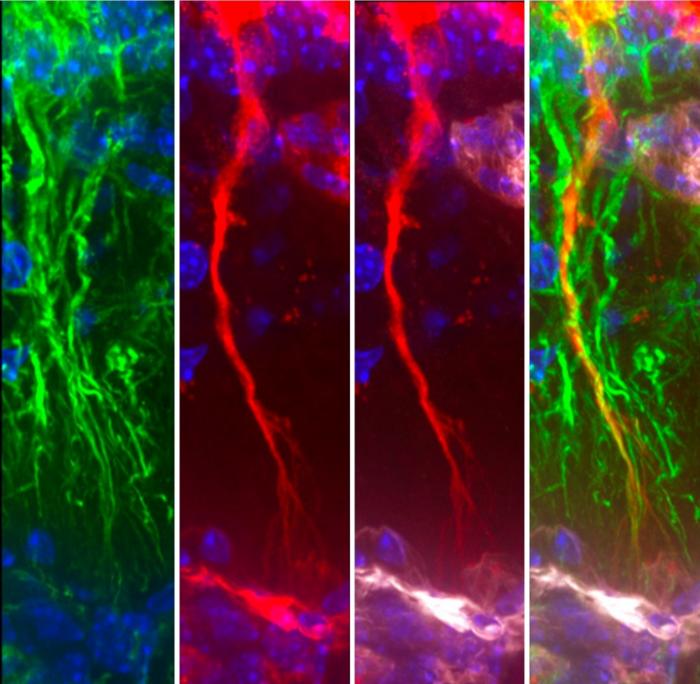
    Tanycytes in green capturing Tau protein in red.
    Share
    Facebook Twitter LinkedIn Pinterest Email

    Tanycytes in green capturing Tau protein in red. [Vincent Prévot, INSERM]

    Tau‑clearing cells in the brain may offer new clues to slowing Alzheimer’s disease progression, according to a study titled “Tanycytic degeneration impairs tau clearance and contributes to Alzheimer’s disease pathology,” from Kyoto University and INSERM, published in Cell Press Blue. The work identifies a previously unrecognized mechanism by which the tau protein accumulates in the brain—a hallmark of Alzheimer’s pathology—and points to a specialized group of cells, called tanycytes, as key players in clearing tau from the cerebrospinal fluid (CSF) to the blood.

    “Tanycytes, whose cell bodies line the walls and floor of the third ventricle and extend long, slim processes that terminate in ‘endfeet’ that contact these fenestrated capillaries,” act as a shuttle between the CSF and the blood, the authors wrote. The new study suggests they also act as a kind of molecular “exit ramp,” moving tau out of the CSF and into the bloodstream for disposal. When these cells become fragmented, that clearance system falters. Tau, which should be ferried away, instead lingers—much like traffic backing up when a major off‑ramp closes—allowing toxic protein species to accumulate.

    “Our findings reveal a previously underappreciated, disease‑relevant role for tanycytes in neurodegeneration,” said corresponding author Vincent Prévot, PhD, of INSERM. “Focusing on tanycyte health could be a way to improve tau clearance and limit disease progression.”

    Using rodent and cellular models, the researchers showed that tanycytes take up tau from the CSF and release it into pituitary portal capillaries, enabling its entry into the systemic circulation, according to the authors. When the team blocked vesicular transport in tanycytes, tau clearance from CSF to blood slowed dramatically, and tau pathology intensified. As the authors wrote, “Blocking tanycytic vesicular transport blunts CSF‑to‑blood tau efflux and potentiates tau pathology.”

    “We were able to show in rodent and cellular models not only that tanycytes were indeed involved in clearing tau but also that tanycytes in the brains of human Alzheimer’s patients were fragmented and had changes in gene expression related to this shuttle function,” Prévot said in a press release.

    The group then turned to human samples. In postmortem brain tissue from Alzheimer’s patients, tanycytes appeared structurally compromised, with fragmented processes and marked transcriptomic changes—particularly in genes linked to vesicular transport. These alterations captured by single-nucleus RNA sequencing, the authors noted, “[explain] this clearance deficit” and provide the first evidence that tanycytic dysfunction contributes directly to human disease. “Our findings provide the first evidence for structural and functional alterations in these little‑known but key brain cells in human disease,” Prévot said.

    The study also examined tau levels in patient fluids. Individuals with Alzheimer’s showed decreased plasma‑to‑CSF ratios of total and p181 tau, consistent with impaired movement of tau out of the brain and into circulation. Together, the animal, cellular, and human data support the existence of a brain‑to‑blood “tanycytic shuttle” whose breakdown may accelerate tau accumulation.

    The researchers emphasize that maintaining tanycyte function is unlikely to be the sole answer to Alzheimer’s, but it may represent a promising new angle. They also acknowledge key limitations, including the lack of robust animal models that fully recapitulate human disease and the need for larger, longitudinal patient cohorts.

    Still, the work broadens the landscape of Alzheimer’s biology by highlighting a cell type rarely considered in neurodegeneration. By illuminating how tau normally exits the brain—and what happens when that system fails—the study opens the door to potential interventions aimed at preserving or restoring this clearance pathway.

    Alzheimers Degenerating Disrupt Progression Removal shaping Tanycytes Tau
    Share. Facebook Twitter Pinterest LinkedIn Tumblr WhatsApp Email
    Previous ArticleArmored CAR T Cells Score Preclinical Success in Glioma and Ovarian Cancer
    Next Article Alzheimer’s Phase II for TREM2 Antibody Shows No Treatment Benefit
    admin
    • Website

    Related Posts

    Alzheimer’s Phase II for TREM2 Antibody Shows No Treatment Benefit

    March 6, 2026

    Enhancing Quality and Accelerating the Development of Bispecific Antibodies

    March 6, 2026

    Parkinson’s Marker Linked to 20-Fold Faster Alzheimer’s Progression in Women

    March 5, 2026

    A Video Report from AGBT

    February 27, 2026
    Leave A Reply Cancel Reply

    Our Picks

    9 Time-Saving Kitchen Gadgets for Fall at Amazon

    September 5, 2025

    Why Exercise Is So Important For Heart Health, From An MD

    September 5, 2025

    An Engineered Protein Helps Phagocytes Gobble Up Diseased Cells

    September 5, 2025

    How To Get Rid Of Hangnails + Causes From Experts

    September 5, 2025
    • Facebook
    • Twitter
    • Pinterest
    • Instagram
    • YouTube
    • Vimeo
    Don't Miss
    Microbiome

    Alzheimer’s Phase II for TREM2 Antibody Shows No Treatment Benefit

    By adminMarch 6, 20260

    Credit: selvanegra / iStock / Getty Images Plus Another Alzheimer’s antibody comes up short in…

    Degenerating Tanycytes Disrupt Tau Removal, Shaping Alzheimer’s Progression

    March 6, 2026

    Armored CAR T Cells Score Preclinical Success in Glioma and Ovarian Cancer

    March 6, 2026

    Enhancing Quality and Accelerating the Development of Bispecific Antibodies

    March 6, 2026

    Subscribe to Updates

    Get the latest creative news from SmartMag about art & design.

    About Us

    At FineGut, our mission is simple: to enhance your self-awareness when it comes to your gut health. We believe that a healthy gut is the foundation of overall well-being, and understanding the brain–gut connection can truly transform the way you live.

    Our Picks

    9 Time-Saving Kitchen Gadgets for Fall at Amazon

    September 5, 2025

    Why Exercise Is So Important For Heart Health, From An MD

    September 5, 2025

    An Engineered Protein Helps Phagocytes Gobble Up Diseased Cells

    September 5, 2025
    Gut Health

    Alzheimer’s Phase II for TREM2 Antibody Shows No Treatment Benefit

    March 6, 2026

    Degenerating Tanycytes Disrupt Tau Removal, Shaping Alzheimer’s Progression

    March 6, 2026

    Armored CAR T Cells Score Preclinical Success in Glioma and Ovarian Cancer

    March 6, 2026
    X (Twitter) YouTube
    • Contact us
    • Privacy Policy
    • Disclaimer
    • Terms and Conditions
    © 2026 finegut.com. Designed by Pro.

    Type above and press Enter to search. Press Esc to cancel.