

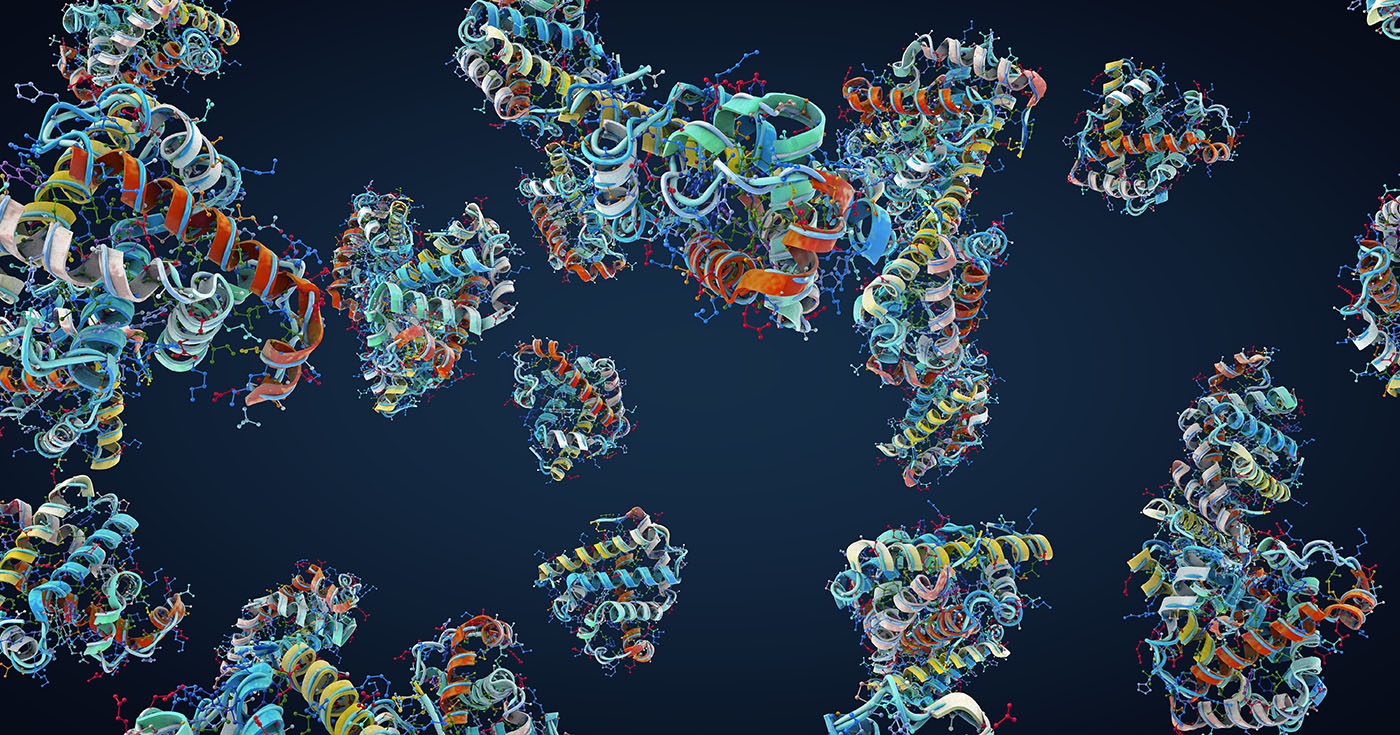
Scientists have developed a novel protein evolution approach dubbed optovolution that uses light to guide the evolution of proteins with dynamic, multi-state, and computational functions based on specific rules. Details of the work are published in a new Cell paper titled “Light-directed evolution of dynamic, multi-state, and computational protein functionalities.” The research was led by scientists at the Swiss Federal Technology Institute of Lausanne (EPFL).
Over the years, scientists have developed various methods for directed evolution of proteins like enzymes and antibodies that are used in household detergents, medicine, and other industries. The challenge with these existing methods is that they are always strongly active which is inconsistent with how biology naturally works. Signaling proteins, protein “switches,” and protein “logic gates”—proteins that combine multiple inputs to make yes or no decisions—change states over time depending on the need. Thus, if a directed evolution approach only selects for one state, the other important states of a protein can lose function or fail to switch properly, which can be biologically detrimental.
The method described in the Cell paper addresses the challenge by using light to guide the evolution of dynamic, multi-state proteins. The team, led by Sahand Jamal Rahi, PhD, an assistant professor in EPFL’s laboratory of the physics of biological systems, built their system by rewiring the cell cycle of Saccharomyces cerevisiae (brewer’s yeast) so that its progression depended on the protein to be evolved, switching cleanly between on and off states.
The key, they explained, was linking the protein’s output signal to a cell‑cycle regulator that is essential at one stage but toxic at another. If the protein of interest stayed on or off for too long, the yeast cell stalled or died. Only cells in which the protein oscillated correctly could keep dividing.
Furthermore, the approach uses optogenetics—a technique that switches genes on and off with light—to maintain precise control of the process. With this technique, the researchers controlled proteins of interest so that they flipped states with timed light pulses. Each roughly 90‑minute cell cycle acted as a rapid pass‑fail test of whether the protein switched at the right moment. In this way, this optovolution method favors variants with better dynamics, without manual screening or repeated interventions. Overall, the technique brings the process of directed evolution closer to how cells actually operate where timing and switching matter as much as strength, according to the scientists.
To demonstrate that their approach works, the team used it to evolve several classes of proteins. First, they improved a widely used light‑controlled transcription factor. Specifically, they obtained 19 new variants that were either more sensitive to light, less active in the dark, or responsive to green rather than only blue light. The team also evolved a red‑light optogenetic system so that, in yeast, it no longer had to be supplemented with a chemical cofactor. They also ran experiments that showed that optovolution is not limited to light‑sensing proteins. Specifically, they evolved a transcription factor that behaves as a single-protein computer, which activates genes only when two different inputs were present simultaneously: a light signal and a chemical signal.
The scientists believe that optovolution opens new possibilities for synthetic biology, biotechnology, and basic research applications. For example, scientists could use the method to build smarter cellular circuits, develop optogenetic systems that can be independently controlled with different colors of light, and explore how complex protein behaviors emerge through evolution.
