

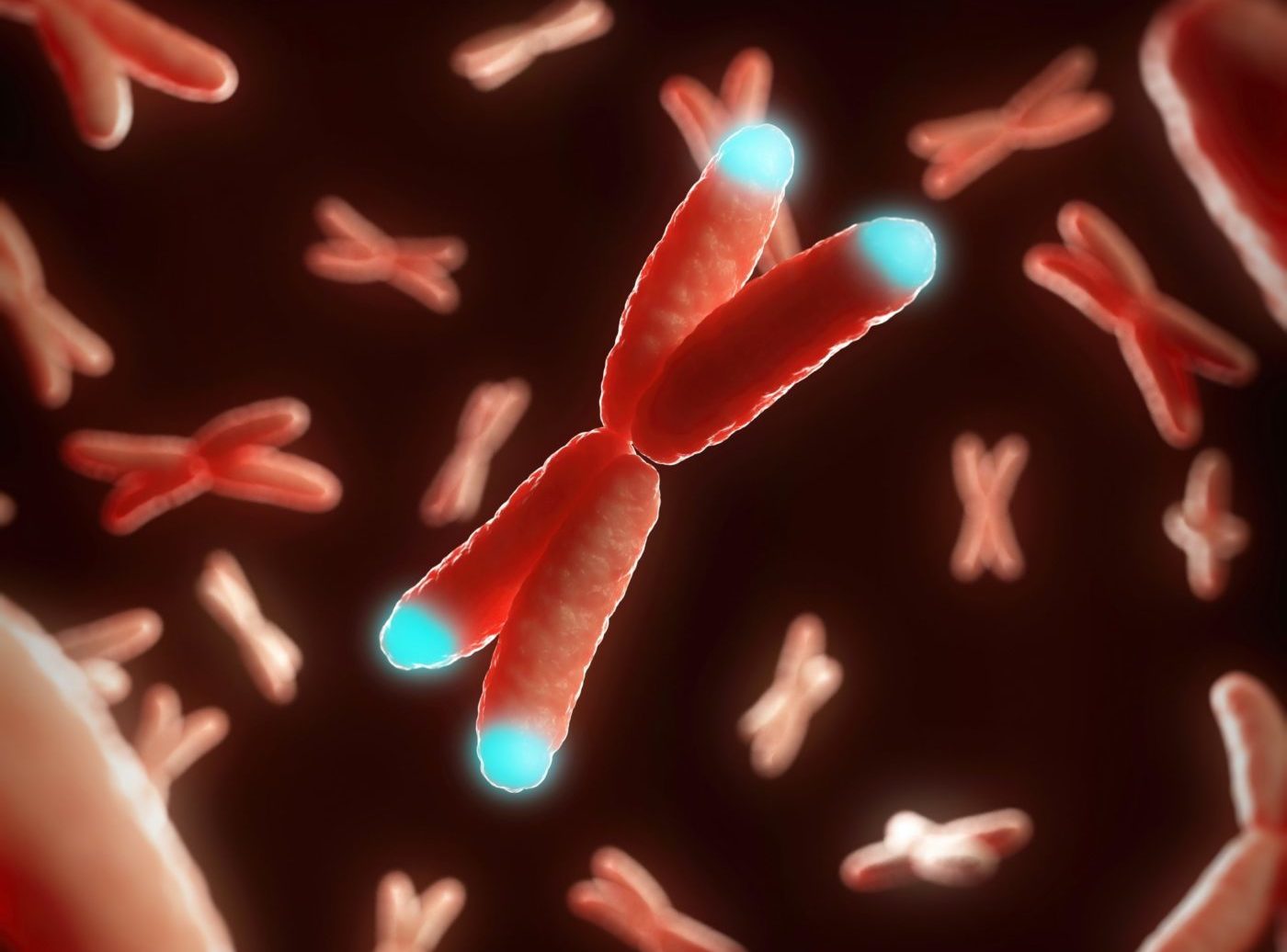
Scientists at Sanford Burnham Prebys Medical Discovery Institute have developed a new computational tool, TLPath, that can infer changes occurring at the ends of chromosomes—the telomeres—by detecting structural alterations in cells and tissues captured in images taken of routine medical biopsies.
Telomeres are repeating sections of DNA at the ends of chromosomes, which serve a protective function, but progressively shorten with each cell division. Telomere shortening has been recognized as one of the hallmarks of aging, but current methods for measuring telomeres are complex, which prevents large-scale studies.
Research lead Sanju Sinha, PhD, an assistant professor in the Cancer Metabolism and Microenvironment Program at Sanford Burnham Prebys, and colleagues developed TLPath based on the hypothesis that modifications in the shape and structure of cells and tissues could be used to predict telomere length. They showed in testing that TLPath succeeded in more accurately predicting telomere length from routinely available hematoxylin and eosin (H&E)-stained histopathology images than basing the prediction solely on the age of patients when they donated their samples. The scientists further evaluated the model’s prediction capabilities by demonstrating that it could identify telomere length differences between individuals of the exact same chronological age.
“This has the potential to transform our ability to study telomere biology, learn more about human aging, and ultimately help people preserve better health as they age,” stated Sinha. “The only limit to using an approach such as TLPath is the availability of scanned histopathology slides.”
Sinha is senior author of the team’s published paper in Cell Reports Methods, titled “Tissue morphology predicts telomere shortening in human tissues.” In their paper, the researchers concluded: “TLPath enables, for the first time, the prediction of bulk-tissue telomere length directly from standard histopathology images, potentially transforming our ability to study telomere biology at scale.”
Telomeres are nucleoprotein complexes at the ends of chromosomes that “… serve as guardians of genomic integrity by preventing chromosome ends from being recognized as DNA double-strand breaks,” the authors wrote. “Whenever DNA gets replicated as our cells grow and divide, the part at the end of the DNA cannot be replicated,” added Sinha. “This would be a problem if our DNA was degraded bit by bit from birth, but instead our cells evolved a unique solution of capping the ends of DNA with repeating regions called telomeres that can be whittled down instead of more essential genetic information.”
These telomere sections progressively shorten with each cell division, until eventually their protective capacity is compromised. “This triggers a DNA damage response, leading to cellular senescence,” the team continued. ”Importantly, even a few critically short telomeres are sufficient to trigger senescence, regardless of average telomere length.”
Telomeres are thus more than genetic buffers to be freely discarded. While scientists are still determining exactly how these DNA bumpers affect the aging process, researchers have found that the length of telomeres is correlated with a person’s chronological age throughout their lifespan. After tracking health outcomes in large populations, telomere length was found to predict patients’ risk of chronic diseases associated with aging.
“We were reasonably certain that telomeres play an important role as cells age, and we knew the field needed more ways to study this phenomenon to learn how it can be treated to benefit patients,” said Sinha. However, all current approaches to measuring telomere length require specialized molecular techniques that represent a real barrier to large-scale studies.
Recent advances in computational pathology have demonstrated the potential to predict molecular properties, including mutation status, gene expression profiles, and chromosomal alteration, from high-resolution tissue images, the team continued. This points to the potential that evaluating cellular morphology from routinely available tissue histology might have predictive utility for determining tissue telomere length, without the need for specialized molecular techniques. “Considering that telomere length is a molecular hallmark of aging, the ability to quantify it from routine pathology images could significantly advance the field … We hypothesized that by systematically analyzing cellular morphology in wholeslide images, we could develop a model to predict bulk telomere length measurements.”
To develop TLPath, Sinha and team obtained data from the Genotype-Tissue Expression Project, a major National Institutes of Health (NIH) Common Fund initiative that launched in 2010 to create a resource for studying how inherited changes in genes lead to common diseases. The researchers trained their computational model on scans of 5,263 histopathology slides made from routine biopsy samples of 18 tissue types that were donated by 919 individuals.
“The dataset pairs these high-resolution images with laboratory tests of telomere length, enabling us to train TLPath to find predictive features in the cells and tissue,” explained Sinha. “There are hundreds of terabytes of imaging data from this project ripe for study with tools such as TLPath, and we could not have finished our project without this data being available to researchers.”
The model works by segmenting each histopathology slide into an average of 1,387 square fragments. Each fragment, known as a patch, is scoured to find up to 1,024 structural features. By computing a statistical weight for each feature on each patch, the model compares an overall score for each histopathology slide with the paired telomere length to learn how to predict the latter from the former.
After training TLPath separately on each tissue type, the scientists found it capable of predicting relative telomere length (RTL) on samples from the Genotype-Tissue Expression Project that had not been included in the training dataset. “Mechanistic interpretation of the model revealed that TLPath determines short telomere samples using senescence-like cell morphology (high nuclear-to-cytoplasmic ratio), along with tissue damage (necrosis) and fascia-like structures,” the authors stated.
“The key to our work was building on recent developments in computer vision for histopathology slides, which is the creation of foundation models,” said Sinha. “These models don’t look at discrete pixels, but instead define more higher-order features, only some of which can be interpreted by humans, yet can be validated for their predictive power … This opens up new opportunities based on the conceptual advancement that measurable structural changes in cells can predict the length of telomeres. Directly measuring telomere length requires more complicated and costly tests that are difficult to scale.”
While these slides are commonly created from biopsies for pathologists to review in the course of clinical care, they are rarely digitized and made available to researchers in a similar manner as the NIH-funded Genotype-Tissue Expression Project. “Whether it is new slides being developed today or those preserved in biobanks, all we need is for them to be properly scanned, stored, and shared in order to enable large-scale studies,” said Sinha.
To our knowledge, this is the first approach capable of predicting RTL from H&E slides, offering a new window into telomere research through machine learning analysis of tissue morphology,” the authors stated in their report. “TLPath outperformed chronological age in predicting telomere length, demonstrating H&E-based morphology’s ability to capture individual-specific telomere information.”
