

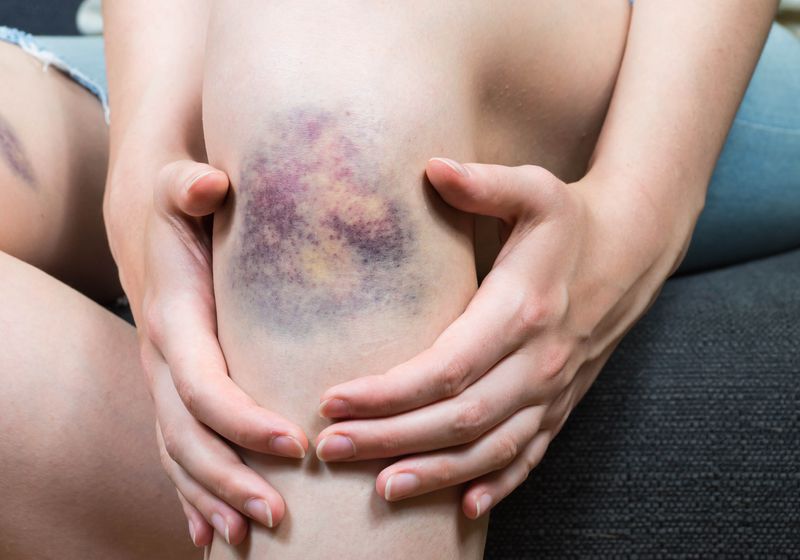
From purple to yellow, bruises change color as they heal. But skin tone and other factors alter how they look. A scientist is using a paintball gun to find a better way to detect them.
A bump against a table corner or a fall while playing a spirited game of catch—life is full of these little encounters that slip by unnoticed, until the next morning when the skin reveals what wasn’t seen before: a bruise.1 What appears as a red or purplish skin contusion in the beginning, slowly transitions to green, yellow, and finally brown, before disappearing entirely. What are the mechanisms that produce this bouquet of bruise colors?
At the onset of an injury, small blood vessels under the skin, called capillaries, can get crushed, leading to localized bleeding. If the skin breaks during the injury, the blood oozes out, and a wound forms. But if the skin stays intact, the blood cells have nowhere to go and thus accumulate in a clump at the site of trauma, forming a bruise that appears red or pink. Once out of the capillaries, the hemoglobin in the red blood cells deoxygenates, imparting a black and blue hue to the bruise.2 Soon, immune cells land at the site to clear off the cellular debris. Enzymes within the immune cells start to break down hemoglobin into a green colored pigment called biliverdin, which is further metabolized into a yellow tinged waste product called bilirubin.3,4 Finally, after days or weeks, depending on the size of the initial bruise, what’s left is the iron component of hemoglobin, which makes the bruise appear brown.
Though this is the conventional understanding of how bruises age, there are many factors that can alter their manifestation and detection across the population: depth of injury, levels of fat at the site, temperature, and skin color, among others.5 “Our classic understanding of that bruise coloration comes from Caucasian skin,” said Katherin Scafide, a forensic nurse and a bruise scientist at George Mason University. “So, obviously, a fresh bruise on someone with really dark skin is not going to look red or blue. It’s not going to go through the same kind of coloration.” Melanin, the pigment that imparts skin color, sits right above the layer where bruises occur. Varying concentrations of this biomolecule can affect how a bruise looks and consequently how accurately it is detected. “Just because you don’t see anything, it doesn’t mean that there’s nothing there,” Scafide said.
Katherine Scafide is a forensic nurse at George Mason University where she investigates different ways to improve bruise detection across diverse skin tones.
Katherine Scafide
She examines different ways to reduce bias in bruise detection. But to do that, she creates bruises first, an occupational necessity that has earned her the title of the “paintball lady.” As the name suggests, Scafide uses paintball guns to create small bruises on volunteers’ skins and studies how parameters like body fat percentage and skin color alter their coloration. “Imagine a bodybuilder with very big arm muscles,” she said. “If I create a bruise on them, I see nothing because there’s very little subcutaneous fat, which often holds the blood vessels that result in the bleeding.”
Bruise hues can also vary based on the site and depth of the injury. Scafide also creates bruises by dropping weights on the arms of volunteers and has noticed that such injuries can take up to a day to turn up on the skin, by which time it might look older than one would anticipate.
Anecdotal evidence suggests that applying ice to a fresh bruise can hasten its healing. But experiments indicate otherwise. In the early 1960s, scientists created bruises on chickens kept in either cold or warm temperatures and noticed that the former group had very little bruising, but they took longer to heal. “When we have an injury, we often put ice on it, to reduce the swelling, and that’s all great in the short term. But if you use ice too much, it can take longer to heal,” Scafide said. While cold temperatures limit the amount of bleeding, the reduced circulation also hampers the delivery of essential healing cells and biomolecules to the bruise, ultimately delaying the removal of dead cells and recuperation of the tissue.6
Now, Scafide researches methods to reduce bias in bruise detection, primarily focusing on using alternate light sources. Every pigment at varying stages of a bruise has a unique absorption spectrum and reflects light differently. A bruise may appear greener or bluer depending on the light source used to view it. Scafide suggests that using lights of suitable wavelengths could improve detection accuracy and eliminate a lot of the reflected light that would prevent one from seeing the bruise. In a randomized controlled trial where Scafide and her team examined 2,903 bruises, using light of specific wavelengths significantly increased the odds of bruise detection as compared to white light.7
“Our existing method of assessing skin has too much bias in it. We need to come up with better, different ways, different approaches,” she said. Going forward, Scafide thinks artificial intelligence is going to be an essential tool to help address some of these issues.
- Jeney V, et al. Natural history of the bruise: Formation, elimination, and biological effects of oxidized hemoglobin. Oxid Med Cell Longev. 2013;2013(1):703571.
- Chhem-Kieth S, et al. Investigation of nitrite alternatives for the color stabilization of heme–iron hydrolysates. J Food Sci Technol. 2018;55(10):4287-4296.
- Wegiel B, Otterbein L. Go green: The anti-inflammatory effects of biliverdin reductase. Front Pharmacol. 2012;3:47.
- McDonnell MC, Mohiuddin SS. Biochemistry, Biliverdin. In: StatPearls. StatPearls Publishing; 2025.
- Nash KR, Sheridan DJ. Can one accurately date a bruise? State of the science. J Forensic Nurs. 2009;5(1):31-37.
- Wang Z, Ni G. Is it time to put traditional cold therapy in rehabilitation of soft-tissue injuries out to pasture? World J Clin Cases. 2021; 16;9(17):4116–4122.
- Scafide KN, et al. Detection of inflicted bruises by alternate light: Results of a randomized controlled trial. J Forensic Sci. 2020;65(4):1191-1198.
