

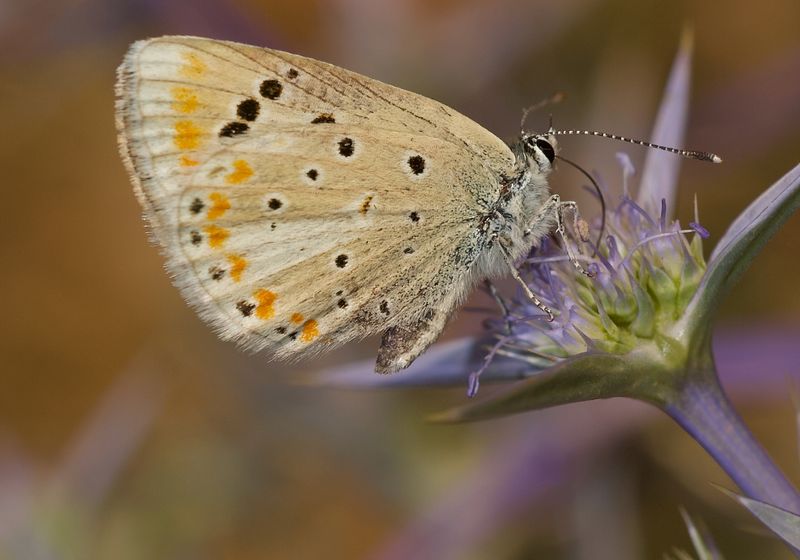
Scientists recently sequenced the genome of the Atlas blue butterfly for the first time. They discovered 227 pairs of small autosomes, which likely formed through fragmentation, and 2 large sex chromosomes.
Image credit:Roger Vila
The Atlas blue butterfly (Polyommatus atlantica), which is native to Morocco and Algeria, is estimated to have about seven times as many chromosomes as most other butterflies and nearly 10 times as many chromosomes as humans.
Scientists have long suspected that P. atlantica carries more chromosomes than other non-polyploid animals (those with no more than two sets of chromosomes), but they had never sequenced the genome of this elusive butterfly species—until now.
“When we set out to start to understand evolution in butterflies, we knew we had to sequence the most extreme, and somewhat mysterious, Atlas blue butterfly,” said Charlotte Wright, an evolutionary biologist at the Wellcome Sanger Institute in a statement.
In a recent study, Wright and her colleagues discovered that P. atlantica boasts a whopping 229 pairs of chromosomes, and this sizable genome likely resulted from its ancestor’s chromosomes fragmenting into small pieces, rather than duplicating.1 The researchers also found that these events of genome fragmentation, also known as fission, likely occurred in the more loosely packed and transcriptionally active parts of the chromosome. Their findings, published in Current Biology, shed light on how the Atlas blue butterfly evolved and provide hints on how it may adapt in the future.
The researchers evaluated the three-dimensional organization of P. atlantica’s genome using a sequencing approach called Hi-C.2 By doing this, they found that the butterfly has 227 pairs of small, equally sized autosomes and two pairs of large sex chromosomes.
The researchers noted that P. atlantica’s autosomes were distinctively smaller compared to those of other butterflies and moths, suggesting that they likely formed via fission events. To test this hypothesis, the team compared P. atlantica’s genome to that of the common blue butterfly, a closely related species that only has 23 pairs of chromosomes. By evaluating both the length and sequence of these chromosomes, the team gathered that indeed, P. atlantica’s large number of small autosomes likely resulted from genome fragmentation, not duplication.
“Breaking down [of] chromosomes has been seen in other species of butterflies, but not on this level,” said Roger Vila, an evolutionary biologist at the Institute of Evolutionary Biology and coauthor of the study.
Next, the researchers wanted to know if certain parts of the butterfly genome were more prone to fission. To do this, they annotated the genome of a close but evolutionarily older relative of P. atlantica, which represented a pre-fragmentation chromatin landscape, for loosely packed and transcriptionally active (A), densely packed and transcriptionally inactive (B), or intermediate (S) regions. The team found that fragmentation sites were largely enriched in A regions and depleted in B regions, indicating that loosely packed genomic sites likely made the frequent chromosome fission events in P. atlantica possible.
According to Vila, the extent of P. atlantica’s genome fragmentation suggests that there are evolutionary reasons for this process, and scientists can now begin to explore them. Wright agreed, “We can start to investigate what benefits [fission] might have, how it impacts [the Atlas blue butterflies’] ability to adapt to their environment, and whether there are any lessons we can learn from their DNA that might aid conservation in the future.”
Mark Blaxter, an evolutionary geneticist at the Wellcome Sanger Institute and a coauthor of the study, thought that the team’s discovery in butterflies may also have implications for human diseases. “Rearranging chromosomes is also seen in human cancer cells, and understanding this process in the Atlas blue butterfly could help find ways to limit or stop this in cancer cells in the future,” he said.
