

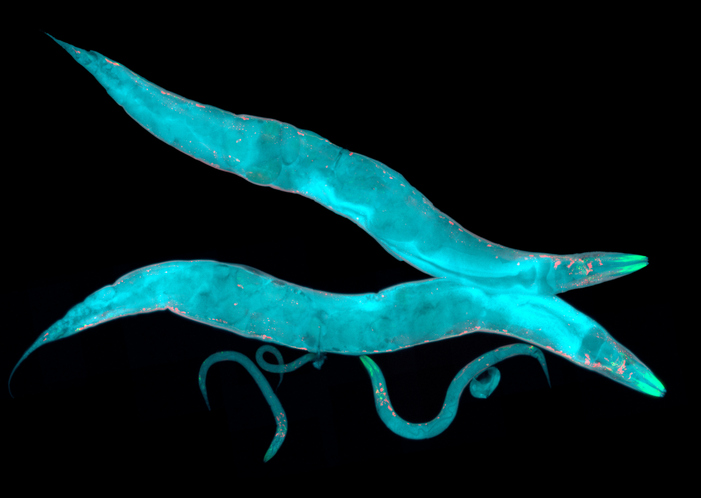
UC Davis researchers tracked the movement of fluorescent particles inside the cells of microscopic worms, providing novel insights into cellular crowding in a multicellular animal. They found that the cytoplasm inside the worms was significantly more crowded and compartmentalized than in single-celled yeast or mammalian tissue culture cells, which are more commonly used to gauge internal cellular dynamics.
The scientists published their study “Giant KASH proteins and ribosomes establish distinct cytoplasmic biophysical properties in vivo” in Science Advances.
This difference highlights the importance of studying cellular processes in living animals rather than cell culture, said first author Xiangyi Ding, a doctoral candidate in the integrative genetics and genomics graduate group.
“This changes everything,” she added. “Crowding in a cell affects any process that depends on molecule movement and interaction, including drug delivery, disease progression, and how cells respond to stress.”
To investigate how particles move inside multicellular organisms, the team, co-led by Daniel Starr, PhD, a professor of molecular and cellular biology, and G.W. Gant Luxton, PhD, an associate adjunct professor of molecular and cellular biology, used Genetically Encoded Multimeric Nanoparticles (GEMs), which are based on naturally occurring proteins that self-assemble into particles that are around 40 nanometers in diameter, about the size of a ribosome. The GEMs have been altered so that their surfaces are covered in fluorescent tags, which allows their movements to be tracked under the microscope at a rate of up to 50 frames per second.
The researchers inserted the DNA instructions for GEMs into the genome of Caenorhabditis elegans, a microscopic nematode with transparent skin whose internal structures can be easily imaged. The resulting worms developed and behaved normally, but their intestinal and skin cells produced thousands of fluorescently tagged GEMs.
Using time-lapse microscopy videos, the researchers found that, on average, the GEMs moved around 50 times more slowly in C. elegans cells than in cultured mammalian or single yeast cells. They also observed that most GEMs were not only crowded, but restricted to certain areas, suggesting that something was compartmentalizing the cells.
“When we first noticed that the worm cells were constrained, we thought it was a mistake, because this is completely different from what is seen in yeast or mammalian tissue culture cells, which are not constrained,” noted Ding.
What controls cellular compartmentalization?
The scientists wanted to understand how the worm cells maintained this more orderly environment. They started by investigating the role of a large protein called ANC-1 that helps maintain cellular architecture by acting as a scaffold. When they disrupted ANC-1 production, the worms’ cells were just as crowded as before, but the GEMs were no longer constrained to certain parts of the cytoplasm.
Cytoplasmic crowding, on the other hand, was controlled by the concentration of ribosomes—the same structures that control crowding in yeast and tissue-cultured mammalian cells. And when the team disrupted the production of both ANC-1 and ribosomes, the GEMs’ movement became much faster and less restricted.
“This shows that cells use two complementary systems to control particle mobility,” explained Luxton. “The ribosomes are acting like packing peanuts in a box, and the boxes themselves may be the ANC-1 protein complexes. We already knew that ribosomes were acting like packing peanuts, but until now, we didn’t understand how these two pathways worked together.”
Getting GEMs to work in the worms was a challenge that involved years of work.
“It ended up being more difficult than even we imagined,” pointed out Starr. “However, this study highlights the importance of studying cells in living organisms rather than cell culture, because the physical environment of a tissue-cultured cell is so different from anything in an actual organism.”
Now that they’ve developed a system for using GEMs in multicellular animals, the team is excited to investigate other cell types within the worms, such as neurons, to understand how the cytoplasm changes during aging and neurodegeneration. They also plan to use GEMs to investigate particle movement in more complex organisms, starting with zebrafish.
