

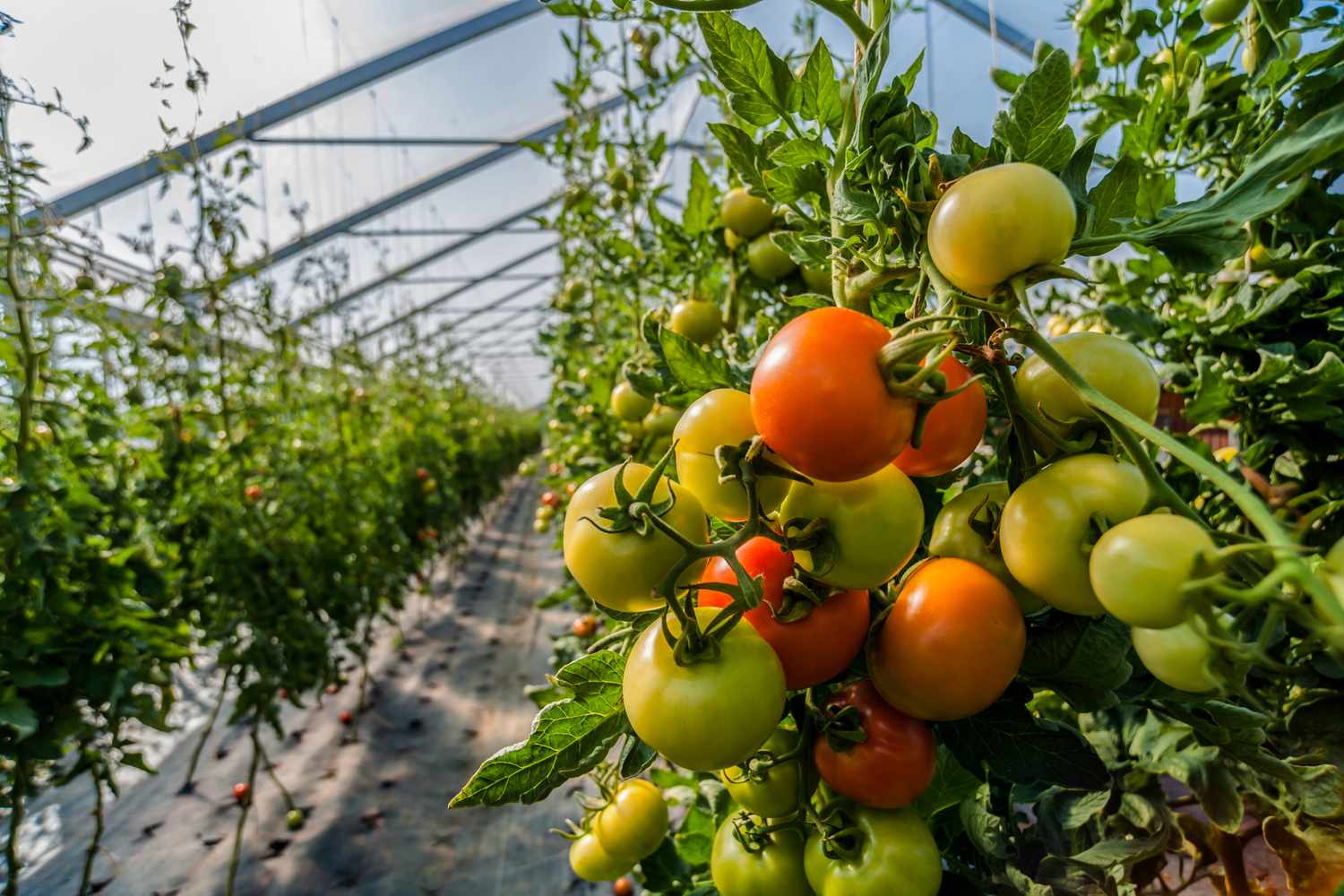
- Tomatoes are loved in the U.S., but drought and climate change threaten their supply.
- Hydroponics and vertical farming could use up to 90% less water while producing quality tomatoes.
- High costs and labor needs limit growth, but greenhouses could shape the future of farming.
From ketchup on burgers to the sauce on pizza, tomatoes find their way into many of America’s favorite foods. In fact, tomatoes are one of the most-eaten vegetables in the U.S., second only to potatoes. The average American eats more than 30 pounds of them each year. Because they’re packed with the antioxidant lycopene, eating tomatoes regularly can be a major boon to your health, whether you slice them up fresh or add them sun-dried to your favorite recipe.
Although they originated in South America, the popular veggies became a phenomenon nearly everywhere on the planet in the second half of last millennium. Today, beloved tomato recipes span the globe, from shakshuka to pico de gallo.
By some estimates, about 30% of the world’s tomatoes, roughly 26.4 billion pounds annually, are grown in California. But since 2022, droughts, some quite severe, have threatened this especially water-intensive crop. “The tomato is what we call a heavy feeder,” says Joe Masabni, Ph.D., a professor and extension specialist at the Texas A&M AgriLife Research and Extension Center. “It needs a lot of water and a lot of fertilizer for an optimum crop.”
With climate change expected to increase the frequency and severity of droughts—and potentially expand drought-prone regions—tomato production could face even greater challenges in the years ahead. Fortunately, agricultural scientists are working on innovative solutions to help ensure that tomatoes can continue to thrive, even when water is scarce.
The Promise of Indoor Farming
Daniel Wells, Ph.D., an associate professor of specialty crops at Auburn University in Alabama, has been growing tomatoes hydroponically—using a nutrient-rich water solution instead of soil—for nearly a decade. His research focuses on helping farmers adopt more water-efficient growing methods.
Hydroponic systems, especially those in controlled environments like greenhouses or vertical farms, can significantly reduce water use. While it may sound counterintuitive that growing a crop in water uses less water than a crop grown in a farm field, it’s true—tomatoes grown hydroponically need 80% to 90% less water than those grown in fields. This efficiency comes from recycling water through the systems, rather than water running off fields or evaporating.
That level of control is one just one benefit of growing tomatoes hydroponically. “Another advantage to greenhouse production would be local production,” explains Wells. “You don’t grow tomatoes in Canada year-round, unless you have a greenhouse, right? It reduces seasonality, and it also gets that produce closer to the consumer, so the transportation distance is shortened.”
Masabni also highlights vertical farming as another innovation that conserves both space and water. Instead of spreading out over large fields, hydroponic systems can be stacked vertically—using shelves or tubes—allowing growers to produce more food in a smaller footprint with less water, too.
The Environmental & Economic Trade-Offs
So why aren’t more farmers growing tomatoes indoors? According to Wells, it largely comes down to cost. He quotes an initial cost of between $1 and $3 million per acre to build a high-tech greenhouse, and says they’re an “energy-intensive” endeavor, as heating and cooling is another major expense. By some estimates, this makes greenhouse operations three to five times more expensive to run than a typical farm. Labor also presents an elevated cost. Because hydroponic systems are highly specialized, they demand skilled workers who understand how to operate and maintain the equipment. “When it comes to the biggest expense, I don’t know if labor is No. 1 or electricity is No. 1,” says Masabni. Universities like Auburn and Texas A&M are training new leaders in the field, but both experts agree that a lack of skilled labor is another hurdle for indoor farmers.
Additionally, hydroponically grown tomatoes are sold at a premium, often over $3 to $6 per pound compared to $1 to $2.50 per pound for field-grown tomatoes. However, for consumers, the payoff may be worth it—particularly when it comes to flavor. Wells shares that growing in greenhouses can lead to a higher-quality, more consistent product. “Greenhouse production allows us to get [tomatoes] really close to vine-ripened, and then to the consumer within a day or two. I love the tomatoes that we grow in the greenhouse at our research facility, but I also buy greenhouse-grown tomatoes at the grocery store because they’re just better,” he says.
Masabni adds that quality goes beyond taste. “We are breeding for higher quality, so I hope what’s coming down the line will be proven to have more antioxidants and more vitamins, not just better taste. Hopefully the nutritional quality will help justify the higher cost.”
Is Indoor Tomato Farming Scalable?
Masabni and Wells mention the Netherlands and Spain as world leaders in the practice, and Wells applauds Canada, name-checking Nature Fresh Farms, Pure Flavor and Red Sun Farms. Closer to home, Auburn University has its own successful model, called “Food U.” The university’s growers keep some tomatoes for research, but use the rest to supply campus dining facilities and local restaurants, along with other vegetables grown at the school’s facilities.
Still, the U.S. has yet to fully embrace indoor tomato farming. Instead, the industry has found more traction with leafy greens. The reason? Greens require a lot less light to grow, making them more practical for fully indoor systems. Tomatoes, on the other hand, are a different story. “Even if you were able to produce enough light for a tomato plant, you’d have a tremendous amount of heat that you have to manage. Tomatoes just don’t make sense in a fully indoor system. They make much, much more sense in a greenhouse, where you have some control over the environment, but you’re utilizing free sunlight,” Wells explains.
Our Expert Take
So is growing tomatoes indoors the answer to a drought-ridden world? “In the long run, yes,” says Masabni. “A greenhouse-controlled environment is the solution, because the technology will improve and become more efficient, recycling every drop of water. In the future, it is promising—but maybe not now.” Thanks to educational and research programs like his, we are getting closer every day to large-scale indoor tomato farming being a global reality.
