

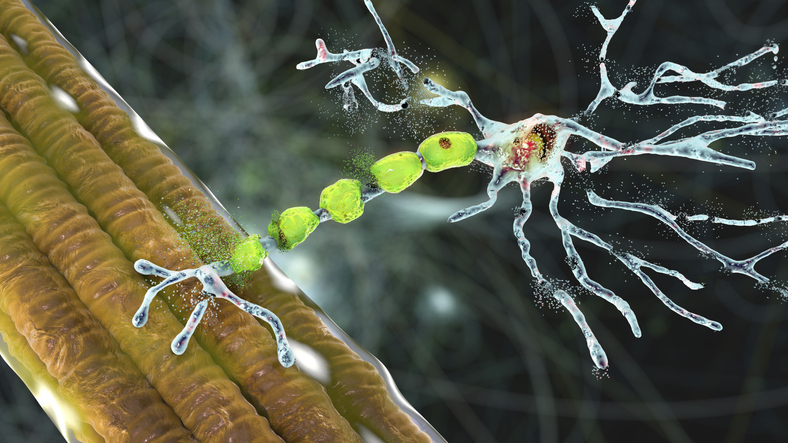
Researchers at the La Jolla Institute for Immunology (LJI) and Columbia University Irving Medical Center have uncovered evidence that amyotrophic lateral sclerosis (ALS) may be an autoimmune disease. The team discovered that inflammatory immune cells, called CD4+ T cells, mistakenly target certain proteins that are part of the nervous system in people with ALS.
“This is the first study to clearly demonstrate that in people with ALS, there is an autoimmune reaction that targets specific proteins associated with the disease,” says LJI Professor Alessandro Sette, PhD, who co-led the study with Professor David Sulzer, PhD, of the Columbia University Irving Medical Center.
The scientists found that people with ALS produce high numbers of CD4+ T cells that target a specific protein (called C9orf72), which is expressed in neurons. This kind of “self-attack” is the defining feature of autoimmune disease.
“There is an autoimmune component to ALS, and this study gives us clues as to why the disease progresses so rapidly,” says Sulzer. “This research also gives us a possible direction for disease treatment.”
The new study “Autoimmune response to C9orf72 protein in amyotrophic lateral sclerosis” appears in Nature. Around 5,000 Americans are diagnosed with amyotrophic lateral sclerosis (ALS) each year. About half of patients die within 14 to 18 months of being diagnosed, usually due to breathing failure. The exact cause of ALS has long been unknown.
Two patient groups with different survival times
Although ALS usually progresses quickly, around ten percent of patients live with the disease for ten years or longer. Baseball player Lou Gehrig passed away just two years after his ALS diagnosis. In contrast, physicist Stephen Hawking, PhD, lived for 55 years following his diagnosis.
Scientists aren’t sure what accounts for this variation. Researchers have linked certain genetic and environmental factors to different ALS “subtypes,” but we don’t have a broad explanation to account for different survival times in the majority of patients.
The new study suggests the immune system plays a big role in patient survival times. By examining T cell responses in ALS patients, the researchers were surprised to find two distinct patient groups. One group had shorter predicted survival times. Their inflammatory CD4+ T cells were quick to release inflammatory mediators when they recognized C9orf72 proteins.
The second patient group also had harmful inflammatory CD4+ T cells, but they also had higher numbers of different T cells, anti-inflammatory CD4+ T cells. This second group also had significantly longer projected survival times.
Anti-inflammatory CD4+ T cells are important because they can regulate disease. When the immune system fights a viral infection, for example, it churns out inflammatory T cells to eliminate the infected cells. Once the immune system clears the virus, anti-inflammatory CD4+ T cells step in to prevent overzealous T cells from damaging healthy tissues.
The scientists weren’t expecting to observe this same process in ALS patients. The new research suggests that CD4+ T cells may reduce harmful autoimmune responses and slow the progression of ALS.
“This protective T-cell response is strongest in people with a longer predicted survival time,” says Emil Johansson, PhD, a visiting scientist in the Sette Lab.
Next steps in ALS research
Future ALS therapies might boost protective CD4+ T cell responses and dial back harmful inflammation, says LJI Research Technician Tanner Michaelis, who served as the study’s first author.
“Hopefully, now that we know the specific target for these immune cells, we can make more effective therapies for ALS,” says Michaelis.
“This approach may be applicable for additional disorders such as Parkinson’s, Huntington’s, and Alzheimer’s,” adds Sette.
In fact, the new research is just the latest breakthrough in the growing field of neuroimmunology. Recent findings from the Sette Lab have also shown connections between autoimmunity and Parkinson’s disease, another disease marked by the death of neurons.
“There are several neurodegenerative diseases where we now have clear evidence of immune cell involvement,” explains Sette. “This is turning out to be more of a rule of neurodegenerative diseases—rather than an exception.”
