

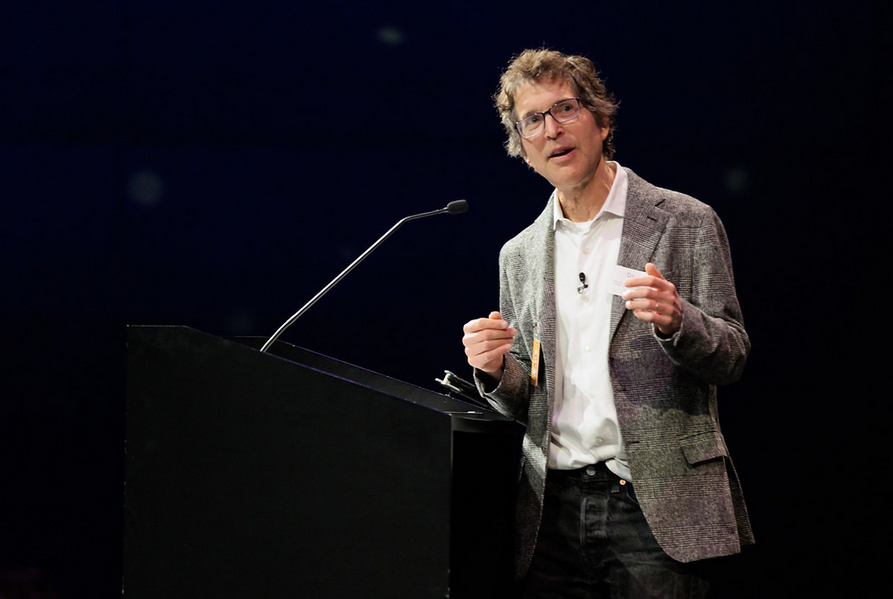
SEATTLE – “Proteins are these beautiful and strange mysteries of nature,” described Nobel Laureate, David Baker, PhD, to an audience of fundraiser donors at the Amazon Meeting Center in downtown Seattle. “For many years, the only proteins we knew were the proteins that were found in nature. In the last 10 years, we’ve figured out how to design new proteins to solve the problems that are facing humanity today.”
Baker, who is the director of the Institute for Protein Design at the University of Washington (UW) and a Howard Hughes Medical Institute (HHMI) investigator, was awarded the 2024 Nobel Prize in Chemistry for pioneering the design of novel proteins for powerful applications, across pharmaceuticals, vaccines, nanomaterials, biosensors, and more.
On the anniversary of his Nobel win, Baker delivered the keynote address at the annual fundraiser, “A Night to Ignite Science,” hosted by the Achievement Rewards College Scientists (ARCS) Foundation Seattle Chapter on October 9. This year’s event raised a whopping $1.3 million to support local students pursuing PhD degrees in science, technology, engineering, and math.
ARCS Foundation was founded in 1958 by a group of women with the goal of elevating the U.S. scientific leadership after the launch of Sputnik, the Earth’s first artificial satellite, by the Soviet Union. Currently, 15 ARCS Foundation regional chapters are established across the U.S.
The nonprofit’s Seattle chapter was founded in 1978 and has since supported over 1,650 fellows. ARCS currently sponsors 114 fellowships at UW and 30 fellowships at Washington State University (WSU). Each ARCS fellowship is a $22,500 cash award ($7,500 per year for three years) with unrestricted use, and can support graduate student cost of living, relocation, and more.
“Tonight we face a sobering reality. Sharp reductions in research threaten opportunities for the very students who will drive tomorrow’s discoveries,” said Margaret Breen, president of ARCS Foundation Seattle Chapter in her opening remarks. “Just as ARCS was created in a moment of national urgency, now’s the time for us to step forward again.”
“We’re in very uncertain financial times. It’s hard on graduate students and it’s also hard on new faculty,” weighed in Baker. He added that funding new students can equally support new faculty at universities in Washington.
Close to being solved
On the morning of Baker’s Nobel Prize win, Jeremiah Sims, PhD, an ARCS scholar and MD/PhD student in the Baker lab, recalled waking up to a flurry of texts and missed calls from friends, family and colleagues, many from the East Coast who had already received the Nobel news. While Seattle scientists are known to “not wake up early,” the lab was packed at 9:00am and poised to erupt in applause once Baker walked through the doors.
“It was truly one of my favorite days in the lab because we celebrated David, who is unsurprisingly one of the most humble and down-to-earth people you may ever meet,” shared Sims as he introduced Baker’s keynote. “David is a master connector for people with massive, crazy scientific ideas. When they work out, it’s pretty cool.”
During his PhD work, Sims developed an effective therapy for treating Nipah and Hendra, two of the most lethal zoonotic viruses with a mortality rate of 40-75%. He is currently working with the National Institute of Health (NIH) to move the treatment further along the drug development path.
In a separate project, Sims developed a massively parallel pipeline to screen tens of thousands of proteins to streamline validation of computational designs. The work offers a valuable advance for a field that has historically been hindered by resource and time-intensive experimental workflows.
“These two problems are very close to being solved because of the one person who is now sharing the stage with me,” declared Baker as he led applause for Sims.
![Baker leads applause for ARCS scholar, Jeremiah Sims. [Kristin Zwiers Photography]](https://www.genengnews.com/wp-content/uploads/2025/10/20251009_David_Baker_Jeremiah_Sims.png)
Sims is one of over 100 researchers working in the Baker lab, many of whom are designing de novo (or from scratch) proteins, leveraging the group’s own RFdiffusion, an AI model which uses a diffusion framework inspired by image generation tools to design new proteins.
Baker’s keynote went forward to highlight the lab’s latest work, including the development of a generalizable molecular on/off switch for applications in tunable cancer immunotherapies published just a few weeks ago in Nature. While high-affinity binding, such as a drug interacting with a target, can lead to potent biological response, this interaction can take a slow time scale of hours to dissociate, creating a dangerous problem for medicines that must be halted in the presence of harmful side effects.
Led by graduate student Adam Broerman, the newly designed molecular switches were shown to facilitate binder dissociation rates as high as 6,000-fold, expanding the power of protein design from generating thermodynamically stable structures to manipulating kinetic rates.
In July, the Baker lab announced the successful design of high affinity binders to disordered proteins, expanding therapeutic access to over 50% of the human proteome. The work led by postdoctoral researchers, Kejia Wu, PhD and Caixuan Liu, PhD, takes an amino acid sequence-based approach, which does not require structural information, to facilitate highly generalizable drug discovery on a new trove of therapy targets.
Among the diverse array of disordered proteins that were successfully targeted included dynorphin, an opioid receptor implicated in chronic pain, a variant of BRCA1, a DNA-repair protein implicated in breast cancer, and amylin, a hormone whose designed binders were shown to dissolve amyloid fibrils associated with type 2 diabetes.
Thus far in 2025, ARCS Foundation Seattle Chapter has awarded $952,500 in fellowships. The nonprofit is poised to continue its mission to support the next generation of scientists with another successful fundraiser in hand.
*David Baker gave the inaugural keynote at GEN‘s virtual event, “The State of AI in Drug Discovery 2024.” Registration is now open for the 2025 event streaming on October 29.
