
Close Menu
My Blog

    Subscribe to Updates

    Get the latest creative news from FooBar about art, design and business.

    What's Hot

    Nautilus debuts Voyager platform in push toward next-gen proteomics

    March 1, 2026

    First-in-Human Success for Prenatal Stem Cell Therapy in Spina Bifida

    February 28, 2026

    Pressure-Driven Pathway Links Liver Congestion to Fibrosis and Cancer

    February 28, 2026
    Facebook X (Twitter) Instagram
    X (Twitter) YouTube
    My BlogMy Blog
    Sunday, March 1
    • Home
    • About Us
    • Healthy Living
    • DNA & Genetics
    • Podcast
    • Shop
    My Blog
    Home»DNA & Genetics»Astrocyte Activity Linked to How Long-Term Memories Are Formed in Mice
    DNA & Genetics

    Astrocyte Activity Linked to How Long-Term Memories Are Formed in Mice

    adminBy adminOctober 16, 2025No Comments3 Mins Read
    Facebook Twitter Pinterest LinkedIn Tumblr WhatsApp VKontakte Email
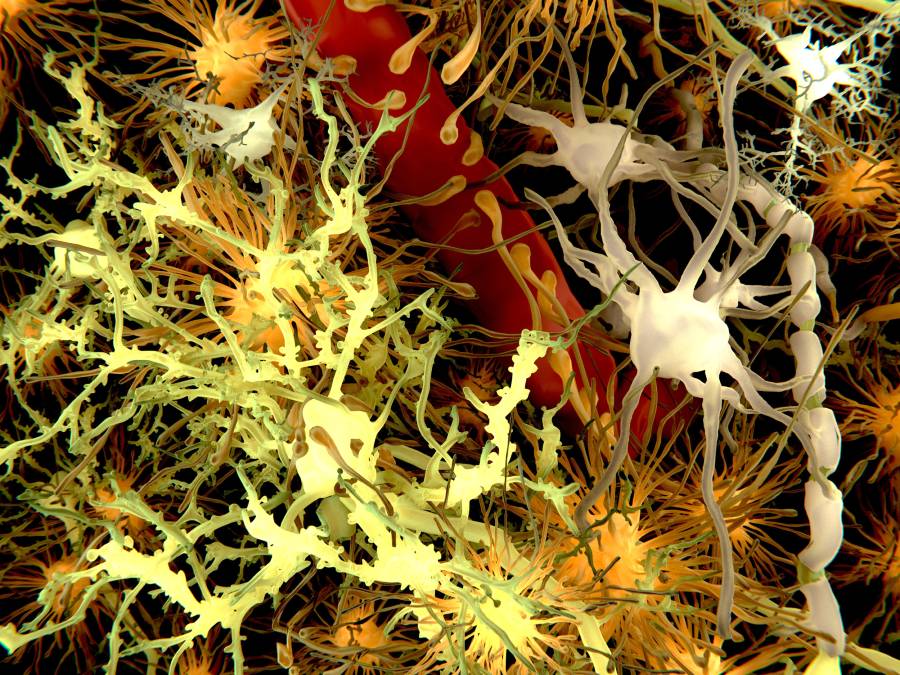
    An image showing the main cells of the brain. In this graphic, yellow: neurons; orange: astrocytes; gray: oligodendrocytes; white: microglia.
    Share
    Facebook Twitter LinkedIn Pinterest Email

    New research led by scientists from the RIKEN Center for Brain Science points to astrocytes as the brain cells responsible for long-term learning and memory. In a new Nature paper, they demonstrate how emotionally intense experiences like fear in mice make their mark on small groups of astrocytes for several days, allowing them to re-engage when the mice recall the experience. Full details are provided in the paper titled “The astrocytic ensemble acts as a multiday trace to stabilize memory.”

    According to the paper, the team led by Jun Nagai, PhD, a principal investigator at RIKEN, investigated the activity of the so-called Fos protein in astrocytes. Traditionally, astrocytes have been thought to have more of a supporting role in the brain. However, when it became clear that engrams—the memory traces that exist in neurons—could not account for stabilized long-term memories, Nagai and his group turned to astrocytes for answers. Neurons produce Fos when activated, as do some astrocytes in response to experiences. 

    To monitor how astrocytes across the brain respond during learning and recall, the scientists devised a method of fluorescently labeling astrocytes with active Fos but not neurons in mice. Furthermore, they only tagged active Fos during a specific time frame, which was controlled by giving the animal a shot of 4-hydroxytamoxifen (4-OHT). 

    Next, they taught the mice to associate a certain cage with an unpleasant experience. The mice were then removed and returned to the cage several days later. Their reaction showed whether or not they remembered the past event. The results showed that, unlike in neurons, the astrocytes had strong Fos activity only during recall but not during the initial learning. Additional testing showed that the Fos activity in astrocytes required input from neurons in the amygdala that formed the relevant fear-memory engram, as well as from neurons that use noradrenaline as a transmitter. 

    Furthermore, single-cell RNA sequencing of the astrocytes showed that in the days following initial exposure to the emotional experience, the astrocytes began to produce alpha and beta adrenoreceptors, which are activated by noradrenaline. These extra adrenoreceptors act as tags that mark which astrocytes should be activated and produce Fos when the mice recall the emotional experience. To test their theory, they blocked Fos+ astrocyte signaling during recall. This resulted in unstable memories for the mice. They also did not seem to remember the cage during the recall test. Then, when the team forced the astrocytes to activate, the mice not only recalled the unpleasant experiences but also generalized their recalled experiences to other cages that had no negative associations. 

    For their next steps, the scientists plan to figure out how astrocytes are selected to gate memory stabilization and to test whether specific types of memories can be suppressed or enhanced by manipulating them.

    In the short term, this discovery could help scientists understand PTSD and related conditions in which emotionally intense memories persist abnormally or are activated by overgeneralized objects in the environment, Nagai said. “These findings could lead to new therapeutic approaches that target the astrocytic memory switch, leading to therapies that gently dampen traumatic memories while sparing others.” 

    Beyond biology, “the astrocyte-tagging process might inspire AI models that mimic human memory filtering,” he added. “Current AI systems are data-hungry and energy-intensive; by learning from astrocytes—which select memories efficiently based on emotional salience and recurrence—we may design more energy-efficient, context-aware AI systems that remember just enough.”

    activity Astrocyte Formed linked LongTerm Memories Mice
    Share. Facebook Twitter Pinterest LinkedIn Tumblr WhatsApp Email
    Previous ArticleBrain training restores youth to aging minds
    Next Article Flush away chronic constipation with magnesium oxide, kiwifruits and psyllium
    admin
    • Website

    Related Posts

    A Video Report from AGBT

    February 27, 2026

    Novo Nordisk, Vivtex Ink Up to $2.1B Deal to Develop Oral Biologics for Metabolic Conditions

    February 27, 2026

    Increasing Rice Yields with Gene-Informed Selective Breeding

    February 27, 2026

    Cigarette Consumption Linked to Rare Ancestry-Specific Coding Variants

    February 27, 2026
    Leave A Reply Cancel Reply

    Our Picks

    9 Time-Saving Kitchen Gadgets for Fall at Amazon

    September 5, 2025

    Why Exercise Is So Important For Heart Health, From An MD

    September 5, 2025

    An Engineered Protein Helps Phagocytes Gobble Up Diseased Cells

    September 5, 2025

    How To Get Rid Of Hangnails + Causes From Experts

    September 5, 2025
    • Facebook
    • Twitter
    • Pinterest
    • Instagram
    • YouTube
    • Vimeo
    Don't Miss
    Longevity

    Nautilus debuts Voyager platform in push toward next-gen proteomics

    By adminMarch 1, 20260

    Company’s new benchtop system promises a clearer view of proteins following validation at a leading…

    First-in-Human Success for Prenatal Stem Cell Therapy in Spina Bifida

    February 28, 2026

    Pressure-Driven Pathway Links Liver Congestion to Fibrosis and Cancer

    February 28, 2026

    A cellular atlas of aging comes into focus

    February 28, 2026

    Subscribe to Updates

    Get the latest creative news from SmartMag about art & design.

    About Us

    At FineGut, our mission is simple: to enhance your self-awareness when it comes to your gut health. We believe that a healthy gut is the foundation of overall well-being, and understanding the brain–gut connection can truly transform the way you live.

    Our Picks

    9 Time-Saving Kitchen Gadgets for Fall at Amazon

    September 5, 2025

    Why Exercise Is So Important For Heart Health, From An MD

    September 5, 2025

    An Engineered Protein Helps Phagocytes Gobble Up Diseased Cells

    September 5, 2025
    Gut Health

    Nautilus debuts Voyager platform in push toward next-gen proteomics

    March 1, 2026

    First-in-Human Success for Prenatal Stem Cell Therapy in Spina Bifida

    February 28, 2026

    Pressure-Driven Pathway Links Liver Congestion to Fibrosis and Cancer

    February 28, 2026
    X (Twitter) YouTube
    • Contact us
    • Privacy Policy
    • Disclaimer
    • Terms and Conditions
    © 2026 finegut.com. Designed by Pro.

    Type above and press Enter to search. Press Esc to cancel.