

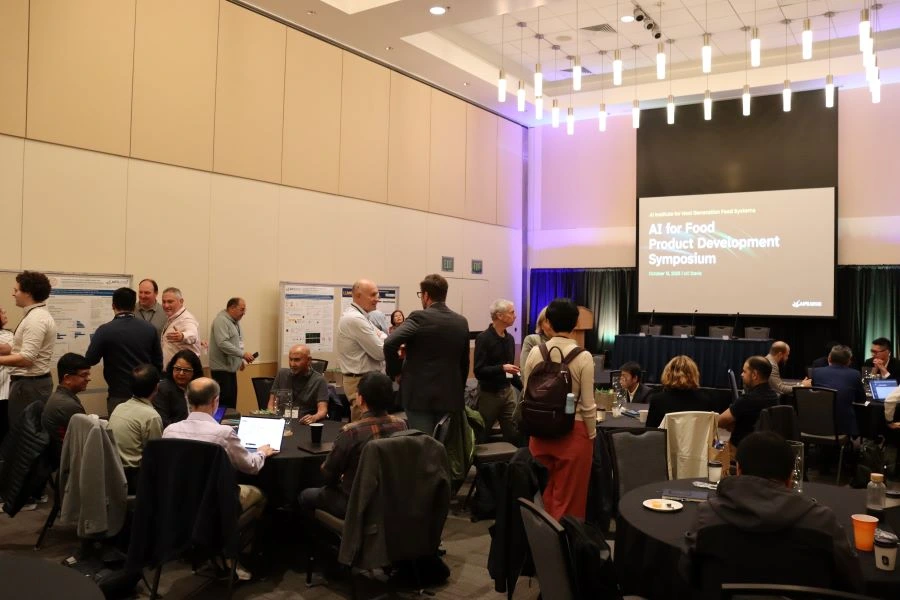
The AI Institute for Next Generation Food System (AIFS) at the University of California (UC) Davis, US, organized the first AI for Food Product Development Symposium to catalyze innovation at the intersection of AI and food science.
Nutrition Insight attended the October 13 event in Davis, where experts from both fields discussed how AI can transform the way food products are designed, developed, and commercialized.
At the event, Dr. Ilias Tagkopoulos, AIFS director and professor of Computer Science at UC Davis, said the institute uses AI to help create a healthier society and a healthier and more sustainable planet by helping to answer key questions on healthy and sustainable foods and production practices.
He noted that many molecules are key to human health, such as macronutrients like protein and fiber, and micronutrients like flavonoids and polyphenols. “How can we, in a very practical way, create better food for our people?”
“Often, we’re waiting to become sick to get better — with drugs or changing our lifestyle,” said Tagkopoulos. “Why can’t we stay healthy and have a better quality of life? To do that, we have to involve food.”
Similarly, he underscored the importance of identifying which food production practices will lead to a healthier society and a sustainable planet.
“Can we connect what’s happening in the farm to what’s happening in our bread or fruit basket? Can you tell me what’s in a tomato, an apple, or a banana, and what it does to our body and mind? Then we go back to the agricultural practices — whether regenerative or traditional — and figure out where to get the best molecules possible.”
To give an example, he referred to a project AIFS runs with the American Heart Association, which compares the molecular composition of almonds, wheat, and apples to different agricultural practices from 100 farms per product.
“We connected the final products and this molecular composition to health effects and bioactivities. For the first time, you can say what we can do in the field that’s great for the product, our society, and the planet.”
“AI as the glue”
AIFS was one of the first seven AI institutes in an initiative mandated by the US Congress, initially receiving US$20 million in funding to leverage AI and improve the food system.
 AIFS focuses on plants, from how to grow, harvest, and process, to the consumer and nutrition.“The way that we positioned AIFS as focusing on plants, looking at all those verticals in food production, from how to grow — molecular breeding and then agricultural production — how to harvest, how to process (food processing), to the consumer and nutrition,” said Tagkopoulos.
“We positioned AI as the glue — the connective extension that brings everything together: data, methods, people.”
AIFS’ vision is a healthier society and a sustainable planet through robust food systems. It aims to achieve this by developing and leveraging transformative AI for the ethical production and distribution of safe, sustainable, and nutritious foods with fewer resources.
The organization’s main clusters cover molecular breeding, agricultural production, food processing and distribution, and nutrition, with ethics, socioeconomics, and core AI technologies as overarching themes.
AIFS conducts a research program, industry and public engagement, and workforce development by preparing undergraduates for a career in AI.
“We said, let’s organize and bring together AI and food by disseminating knowledge, funding research, educating policymakers, senators, and senior staffers, and also running training and outreach programs,” said Tagkopoulos.
Overcoming barriers to AI use
In removing obstacles, Tagkopoulos highlighted the importance of eliminating silos, which is the main driver behind the symposium, bringing AI experts together with food scientists and food development experts.
He added that projects that ask too much from their partners and participants don’t work. “Whatever we do, we need to make it frictionless. We should not ask companies and people to leave their normal day-to-day job and run data acquisition or learn a new tool. Unless there is a clear boost from the business, this is difficult to ask, and I have seen that many times.”
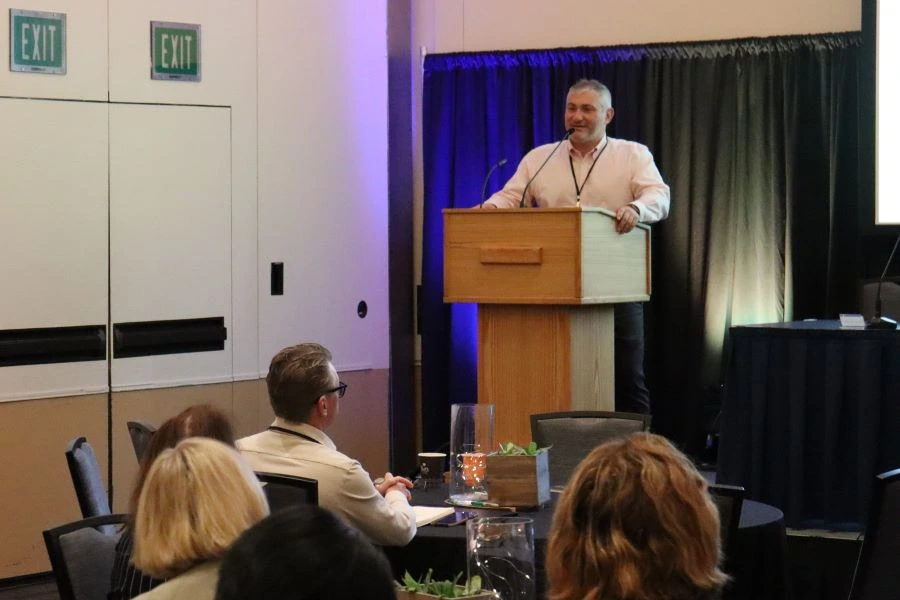 To leverage AI, Tagkopoulos called to remove silos, integrate AI and make it frictionless to use these tools, sell the vision to stakeholders, and train people to co-create solutions.Integration is also key to removing obstacles to AI. “There are many micro-projects here and there — but how do you connect the dots to go from ideation to the final product that is successful to the consumer? That input-output in a modular design is important.”
Tagkopoulos said it’s also important to “sell the dream” or vision to policymakers, CEOs, boards, or the world’s investors.
He underscored that training people is crucial as well. “We don’t know how to work with AI yet.” For example, he said that two years prior, he was looking at references written by ChatGPT, which looked great, but when he followed them, they were hallucinations.
“Now we all know about hallucinations, two years ago we didn’t,” he noted. “There are many other things we don’t know now, and we will know in two years. How do we train our people to be able to co-create and collaborate?”
He added that collaboration is another important element, including co-creating and working together with agents and the AI of tomorrow.
Data complexities in AI food projects
With a Ph.D. in electrical engineering on biological systems and a background in investment banking, Tagkopoulos said he is not an expert in traditional food science. However, he has observed where projects fail and impact is not realized, despite their ideas, applicability, and clear return on investment: “Why? Data.”
He noted that several initiatives are trying to create the right data for food systems, such as the Periodic Table of Food Initiative, which gathers data on food composition.
“We are not there yet,” he cautioned. “If people think that we have AI, we can throw all the data that we have right now, and the AI will come up with an answer — this is not working. Not for food. The reason is: food is multifaceted, multidimensional.”
“If you take most of the hosts — for example, humans or pets — it becomes a huge complexity. It’s very, very difficult. Unless you have billions or trillions of data points — which we don’t have — or billions and billions of dollars, a vision, and perseverance to push that vision, this will not happen. AI by itself will not solve it — for the time being.”
However, he noted that AI can be trained in one set with a lot of data, such as genomes, and then transfer learning to a smaller dataset, such as the function of proteins. “By getting the right data for training, you can create those algorithms that do that.”
 Key gaps need to be solved to scale AI in food innovations, such as data quality and availability, investment, and talent.Tagkopoulos said this is what AlphaFold does. This AI system, developed by Google DeepMind, predicts a protein’s 3D structure from its amino acid sequence. Its database provides open access to over 200 million protein structure predictions.
“The second thing you can do is have agents with LLMs (large language models), but communicate with other tools: computational fluid dynamics, computational chemistry tools, thermal processes, etc. They are very good at solving a particular problem, getting it all together.”
Resource limitations
Tagkopoulos highlighted the interconnectivity between other crucial gaps in using AI : business push and pull, investment, and talent.
“We are going to talk a lot about talent,” he said. “When my students leave, they go for salaries of over US$300,000 right after the exam. Where in the food industry are they going to get those salaries? After five or six years, they’re getting US$700,000 to US$1 million if you go to Google, TikTok, etc. How are you going to pay for that? That’s something we have to think of.”
“Investment is very closely related to that,” he added. “Although this is changing, the best deal for food tech was the worst deal for pharma.”
“Whether we want AI or not is not relevant. We have a common core of algorithms and talent in an area where you’re paid around five times more than others after ten years of experience.”
“How can I bridge that? The answer is, again, looking for AI — making sure that in this trillion-dollar industry, you’re actually going for impact,” he concluded.
